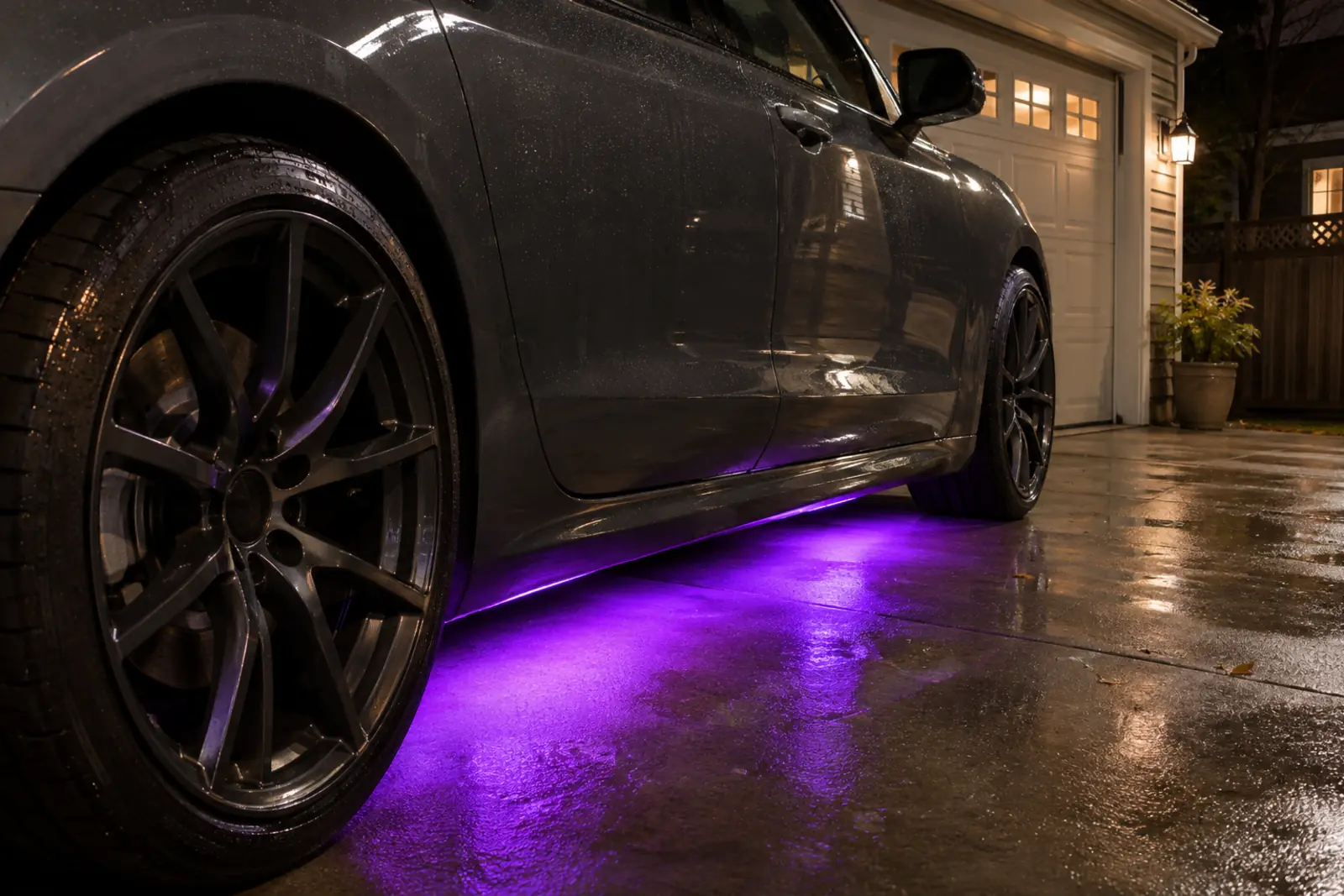
Colored underglow runs against New York's general rule on vehicle lights, and steady white is the only color that rule leaves open. New York Vehicle and Traffic Law section 375(41) says no light other than a white light, and no flashing, revolving, rotating, oscillating or constantly moving white light, may be displayed on a vehicle unless a listed exception applies. Those exceptions cover emergency, hazard and similar vehicles, not decorative kits. Underglow is not named in the statute, so confirm any specific setup with the DMV.
Is underglow illegal in NY? How the law applies
Underglow describes decorative lighting mounted beneath a vehicle to illuminate the pavement around it. Calling a kit “neon,” “accent lighting,” or “LED underbody lighting” does not answer the legal question. What matters is the color it displays, whether it flashes or moves, how bright and glaring it is, and when it is switched on.
Section 375(41) works as a general rule with named exceptions. The general rule is that a vehicle may not display any light other than a white light, and may not display a revolving, rotating, flashing, oscillating or constantly moving white light. The exceptions then reserve specific colors for specific vehicles. A separate glare rule in section 375(2)(b) requires every lamp on a motor vehicle, other than a motorcycle, to be arranged, adjusted and operated so as to avoid dangerous glare or dazzle. The statute text, as read for this guide on the New York State Senate website, contains no word such as “underglow,” “neon” or “decorative,” and no official ruling that classifies underglow was found. That silence is not permission: a colored or moving display is measured against the general rule above.
The guide to New York VTL 375 lighting requirements explains these provisions alongside required vehicle lamps. Keep those functions separate: decorative pavement lighting does not replace headlights, tail lamps, stop lamps, or the rear license plate light.
Underglow colors and the statutory exceptions
The table summarizes the statutory exceptions. It is not a list of permitted underglow colors. A color allowed for a required vehicle lamp does not automatically become acceptable anywhere else on the vehicle.
| Color | What the statute reserves | Note |
|---|---|---|
| Red or red and white | Specified displays for authorized emergency vehicles. | Required red rear lamps serve a separate function; they do not establish permission for red underglow. |
| Blue | Specified fire, police, and ambulance vehicles, and volunteer firefighters’ vehicles. | A decorative blue display should not be assumed acceptable because it points downward. |
| Amber | Specified displays for hazard vehicles. | Do not treat amber underglow as equivalent to a required signal lamp. |
| Green | Specified displays for volunteer ambulance members. | The exception does not establish general permission for green accent lighting. |
| White | The general color restriction distinguishes white from other colors, while also restricting flashing, revolving, or moving white lights. | Steady white underglow is not automatically approved; glare and equipment questions remain. |
| Other colors | No general decorative-lighting exception is identified in the text reviewed. | An unlisted color is not a reliable workaround. Verify with the DMV. |
Is white underglow legal in New York?
White is the one color the general rule in section 375(41) does not bar, so steady white underglow is the least exposed option. It is still not a guaranteed pass. The same rule bars flashing, revolving and moving white lights, and the glare rule applies to every lamp. A bright white strip that dazzles other drivers can raise problems that the color alone does not solve. Treat white as the lowest-risk color, not as an approved one.
Flashing and color-changing modes
A steady display and an animated display raise different questions. Flashing, revolving, and moving white lights are expressly part of the general restriction. A controller that cycles through colors also needs attention because its sequence may display colors associated with statutory exceptions, including red, blue, amber and green.
Do not assume that a slow fade, pulse, chase, or alternating pattern avoids those concerns simply because the controller gives it a different name. The statute text does not classify every decorative animation. Describe the actual behavior when asking the DMV about a setup.
- Check every available mode, including startup sequences.
- Look for a dependable way to keep decorative lighting switched off during road use.
- Check what happens when power is restored or a controller reconnects.
- Do not rely on a selected white setting as proof that the complete installation is acceptable.
Hidden light sources and visible glare
There is a practical difference between seeing a glow on the pavement and looking directly into exposed emitters. Check the vehicle from the front, rear, and both sides. A source hidden from someone standing nearby may still be visible from a lower viewing position.
That check helps identify glare; it does not establish a legal exemption. The statute does not say that underglow becomes permitted whenever its light source is concealed. Downward mounting, a recessed strip, or a diffuser cannot settle the color question.
New York requires lamps to be arranged, adjusted, and operated to avoid dangerous glare or dazzle. If decorative lighting shines directly toward another road user, switching it off addresses the immediate concern while the installation is reviewed. Reducing brightness alone does not resolve whether its color or operating mode is allowed. Section 375(2)(c) also sets a brightness ceiling for lamps on motor vehicles: a light source greater than 32 candlepower is not allowed without commissioner approval, with exemptions for the emergency, hazard and similar colored lights. Many kit listings do not state output in those terms, so a brightness figure on a product page is not a compliance answer.
Show lighting and road use
For a display car, a practical boundary is to reserve decorative lighting for a parked show setting and keep it switched off on the road. This separates the intended display use from driving use. It does not establish that every parked location or show display is exempt from applicable rules.
Before leaving a display, check that the lighting is off and stays off when the vehicle starts. A separate switch can make that routine easier to follow, but the switch itself is not evidence of approval. Verify the installation and intended use with the DMV rather than relying on the description “show only.”
Similar questions arise with light bars and off-road lamps: equipment intended for a particular setting still needs careful consideration before road use. The intended purpose and the actual operating conditions both matter.
Avoid confusion with emergency lighting
Consider what another driver sees before considering the visual effect beside the parked car. Colored flashes beneath a moving vehicle can create uncertainty about its purpose. A display that resembles an emergency or special-vehicle signal deserves particular caution, because red, blue, amber and green are the colors the statute reserves for those vehicles.
Keep required rear lighting clearly distinguishable from decorative effects. The guide to tail light changes in New York explains why rear lighting needs separate attention. An underbody glow cannot compensate for an obscured or malfunctioning required lamp. The same color logic applies to other add-on lamps, as the guide to fog light colors, aim and use in New York shows for front auxiliary lighting.
Tickets, inspection and verification
The Vehicle and Traffic Law has a general penalty provision, section 1800(b)(1), for violations that carry no other specified penalty: a fine of up to $150 for a first conviction. Whether it is the penalty that applies to a particular lighting charge depends on the charge and the court, so treat it as a general reference, not a quote for any specific ticket.
New York safety inspection includes checks of lighting type, operation, mounting, and lens condition; the guide to what is checked on lights at New York inspection covers the details. Do not treat an inspection result as blanket approval for every decorative mode a controller can produce. Explain any added lighting when seeking guidance about the vehicle.
This guide provides general information, not legal advice. Verify the proposed color, modes, mounting, and road use with the New York DMV, and check the official Vehicle and Traffic Law section 375 text before making a decision.
Frequently Asked Questions
Is car underglow legal in New York?
Colored underglow conflicts with the statute's general rule. Section 375(41) bars any light other than white on a vehicle unless an exception applies, and the exceptions are for emergency, hazard and similar vehicles. Steady white is the only color the rule leaves open, and glare rules still apply.
Does New York law specifically ban underglow by name?
The section 375 text reviewed does not name underglow. Its colored-light, flashing-light, glare, and equipment provisions still apply to what the lights display.
Is steady white underglow automatically allowed?
No automatic approval follows from choosing white. White escapes the color restriction only when it is steady, and it must still avoid dangerous glare. Check the proposed use with the DMV.
Is flashing or color-changing underglow legal in New York?
The statute restricts flashing, revolving, rotating, oscillating and constantly moving white lights, and reserves red, blue, amber and green for specified vehicles. A color-cycling controller can run into both limits, so it should be kept off on the road.
Does hiding the light strip make underglow acceptable?
Concealing the source may reduce direct glare, but it does not establish permission. The displayed color and operating mode still matter.
Can underglow be used only for shows?
Keeping decorative lighting off on the road separates show use from driving use. Confirm the rules for the intended display setting rather than assuming parked use is exempt.