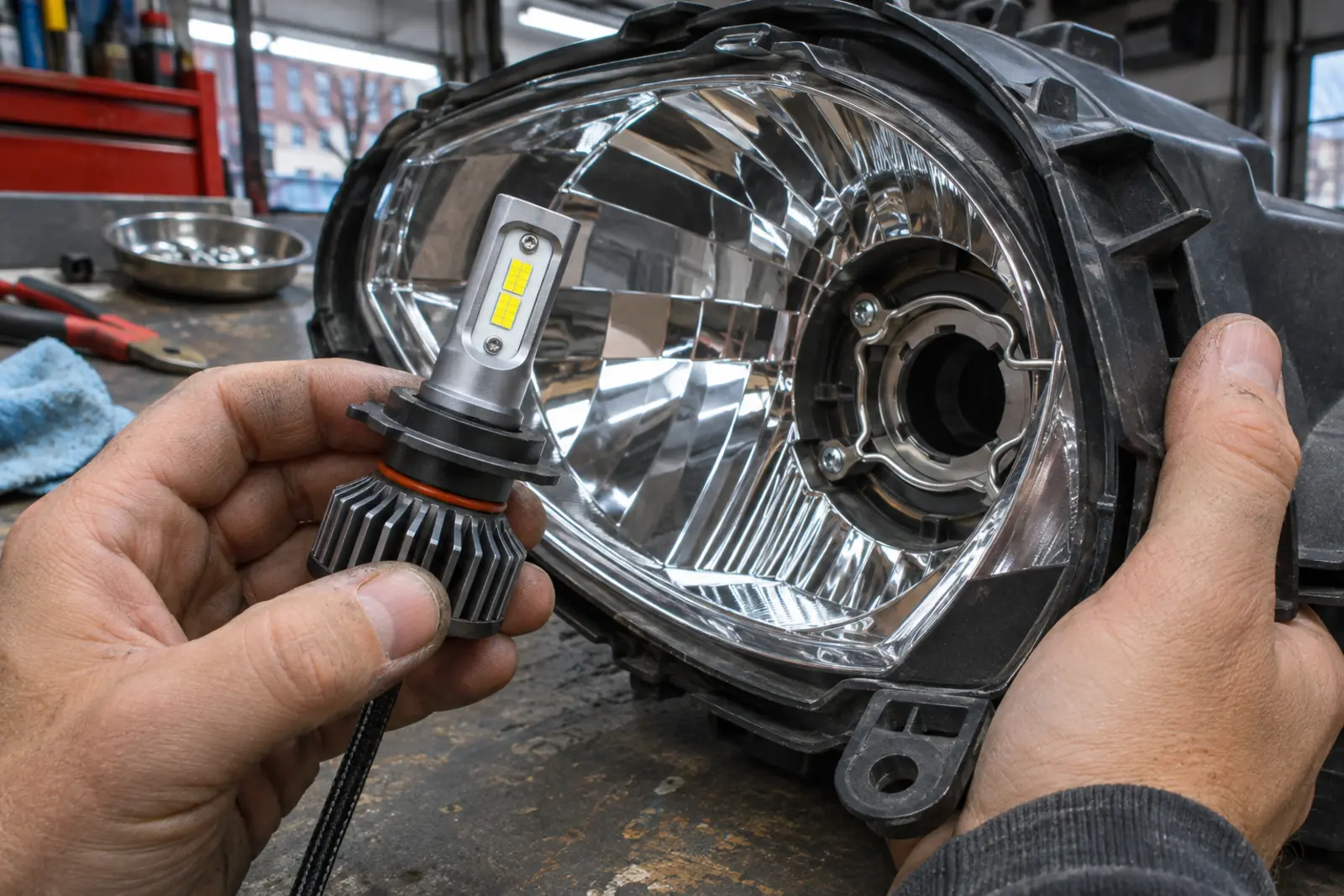
LED headlights are generally legal in New York when they are part of a complete headlamp assembly designed for LED light sources, such as the factory LED headlights on many newer cars. LED retrofit bulbs installed in a halogen headlight housing are the problem. NHTSA’s February 2024 interpretation letter says no LED light source is currently permitted in a replaceable bulb headlamp under federal requirements, while leaving installation to state law. In New York, VTL 375 requires approved headlamps and requires lamps to be arranged, adjusted and operated to avoid dangerous glare or dazzle.
Are LED bulbs legal in halogen headlights?
Under the federal position, no. A halogen headlight is a replaceable bulb headlamp, and NHTSA says no LED light source is currently permitted in one. Under New York law the answer depends on the whole headlamp: it must be approved, and the beam must not cause dangerous glare. A bulb that physically fits the socket does not settle either question.
Factory LED headlights versus LED retrofit bulbs
The two are different products. A factory LED headlamp is an integral beam assembly in which the LED source, heat management and optics were designed and certified together. NHTSA’s letter says LEDs are permitted in that kind of headlamp. A retrofit bulb is a replacement light source pushed into optics designed around a halogen filament. The legal and optical problems described below apply to the second case.
What the federal rule means
FMVSS 108 governs new vehicles and replacement lighting equipment. Its headlamp requirements concern the complete system: the lens, reflector and light source working together. A replaceable bulb headlamp is a bonded lens and reflector assembly with one or two replaceable light sources. Changing the source changes a component of that tested optical system.
The standard itself, 49 CFR 571.108, defines a replaceable light source as an assembly of a capsule, base and terminals designed to conform to appendix A or B of 49 CFR Part 564. The lens of a replaceable bulb headlamp must carry a permanent marking in front of each replaceable light source stating the HB type for a filament light source, or the Part 564 bulb designation for a discharge light source, which ties each housing to a specific source type.
The February 2024 interpretation distinguishes LED sources built into an integral beam headlamp from LED replacement bulbs. LEDs are permitted as part of an integral beam headlamp, but the letter says “no LED light source is currently permitted to be used in a replaceable bulb headlamp.” NHTSA has also warned that nonconforming LED replacement sources are sold online.
Installation being left to state law does not establish that a particular conversion meets New York requirements. A separate federal provision concerning making safety devices inoperative applies to manufacturers, distributors, dealers and motor vehicle repair businesses. The guide to FMVSS 108 and DOT/SAE markings explains the distinction between equipment certification and claims made about replacement parts.
What each requirement covers
| Item | What is regulated | What to check |
|---|---|---|
| Whole headlamp system | FMVSS 108 addresses the lens, reflector and light source together. | Whether the assembly was designed for the source being installed. |
| Light source | NHTSA’s February 2024 letter says no LED source is currently permitted in a replaceable bulb headlamp. | The specified source type, rather than socket fit alone. |
| Lens marking | Headlamp lenses must carry DOT as the manufacturer’s certification. | The lens marking and the assembly’s intended configuration. |
| Installation in New York | State requirements include headlamp approval and avoiding dangerous glare. | Approval, suitability for the vehicle, mounting and adjustment. |
Why a fitting bulb can produce a poor beam
A halogen bulb produces light from a tungsten filament inside a capsule containing halogen gas. The headlamp’s reflector or projector optics are built around that filament’s position. Its location matters because the optics must direct light into a useful beam while controlling light toward other drivers. The comparison of halogen, HID and LED headlights explains how each source type differs.
An LED replacement produces light from diodes instead. If those emitting surfaces do not match the filament position the optics expect, the headlamp can scatter light into unwanted directions. The result can include glare and dark spots within the useful beam. A source that fits the opening can still behave differently inside the housing.
A brighter-looking patch on a wall is therefore not enough to judge the result. Useful lighting depends on where the beam puts light and where it keeps light out. Factory LED headlamps are designed as complete systems, with their light sources, heat management and reflector or projector optics working together.
Aim cannot correct every optical mismatch
Adjustment matters, but lowering a mismatched beam is not proof that the conversion is suitable. Aim changes the direction of the pattern; it does not make the source match the optics. Check headlight aim and adjustment when diagnosing poor illumination, particularly before assuming that a different bulb technology is the answer.
What “plug-and-play” actually tells you
A plug-and-play claim may describe a bulb that fits an existing socket or connects to the vehicle’s wiring. It does not establish that the modified headlamp meets federal equipment requirements, satisfies New York approval requirements or controls glare. Physical compatibility and optical compatibility are separate questions.
Check the following before relying on a replacement claim:
- Specified bulb type: Look in the owner’s manual for the required designation, such as H11 or 9005.
- Intended light source: Check whether the housing was designed for a halogen capsule or an LED system.
- Certification claim: Identify what equipment the claim actually covers.
- Vehicle fit: For a complete replacement assembly, check the equipment manufacturer’s vehicle compatibility guidance.
What the DOT marking does and does not mean
The required DOT symbol belongs on the headlamp lens as the manufacturer’s certification. Under 49 CFR 571.108, that marking applies to original and replacement headlamp lenses alike. A DOT statement on a bulb sticker is not that required lens marking. Nor does an existing DOT symbol establish compliance for every source that can be fitted inside the assembly. The marking must be understood in relation to the headlamp’s designed configuration.
Are LED headlights legal in NY? What VTL 375 says
New York VTL 375 requires headlamps to be approved by the commissioner or to have an approved lens or device. It also requires lamps to be arranged, adjusted and operated to avoid dangerous glare or dazzle. The text does not mention LED bulbs by name, so that absence should not be read as permission for a conversion.
Several parts of the section bear on a retrofit:
- Approval (§ 375(4)): a headlamp may not be used unless it is approved by the commissioner, and the subsection also covers approved lenses and devices.
- Glare (§ 375(2)(b) and (3)): lamps must be arranged, adjusted and operated to avoid dangerous glare or dazzle, and headlamps must be dimmed so dazzling light does not interfere with the driver of an approaching vehicle.
- Matched pair (§ 375(2)(a)(1)): vehicles other than motorcycles must display at least two lighted headlamps, one on each side, “having light sources of equal power.” Fitting an LED bulb on one side only would raise that question.
- Sale (§ 375(7)): the sale of a headlighting device not approved under the section is prohibited.
The guide to New York VTL 375 explains the broader lighting requirements. For the actual wording, check Vehicle and Traffic Law section 375. New York’s safety inspection checks lighting for approved type, operation, mounting and lens condition; working bulbs alone do not address every inspection item. See what is checked on lights at a New York inspection for the inspection side.
What to do instead
- Start with the original specification. Use the owner’s manual to identify the factory-specified halogen bulb type.
- Check the existing headlamps. Look at lens condition, operation, mounting and aim before choosing replacement equipment. Dim output is often a clouded lens rather than a weak bulb; see headlight restoration for yellowed, hazy lenses.
- Replace like for like. The steps are in how to replace a headlight bulb.
- Consider a complete LED headlamp system. Check that the assembly is designed for LED operation, carries the required DOT lens marking and fits the vehicle.
- Verify approval questions. Ask the DMV about New York requirements and NHTSA about federal equipment requirements.
This guide explains equipment and lighting requirements and is not legal advice. Verify current requirements and questions about a particular installation with the New York DMV and NHTSA before making the change.
Frequently Asked Questions
Are LED headlights legal in New York?
Factory LED headlamps are designed as complete LED systems, and NHTSA’s letter says LEDs are permitted in integral beam headlamps. LED retrofit bulbs in halogen housings are a different case, because NHTSA says no LED source is currently permitted in a replaceable bulb headlamp.
Are LED bulbs allowed in halogen headlights in New York?
A socket fit does not establish compliance. NHTSA’s February 2024 letter leaves installation to state law, and New York requires approved headlamps and avoidance of dangerous glare.
Does DOT on the headlight cover an LED bulb conversion?
The lens marking is the manufacturer’s certification for the headlamp’s designed configuration. It does not establish compliance for a different light source installed afterward.
Can adjusting the headlights eliminate LED conversion glare?
Adjustment changes beam direction, but it cannot make an LED source match the filament position expected by halogen optics. A mismatched source can still produce glare and dark spots.
Can I replace only one headlight bulb with an LED?
VTL 375(2)(a)(1) calls for two headlamps, one on each side, having light sources of equal power. A mismatched pair, halogen on one side and a retrofit LED on the other, raises that requirement as well as the approval and glare questions.
What is the practical replacement choice for a halogen headlamp?
Start with the factory-specified halogen bulb. For an LED change, assess a complete assembly designed for LED operation, checking its DOT lens marking, vehicle fit and applicable approval requirements.