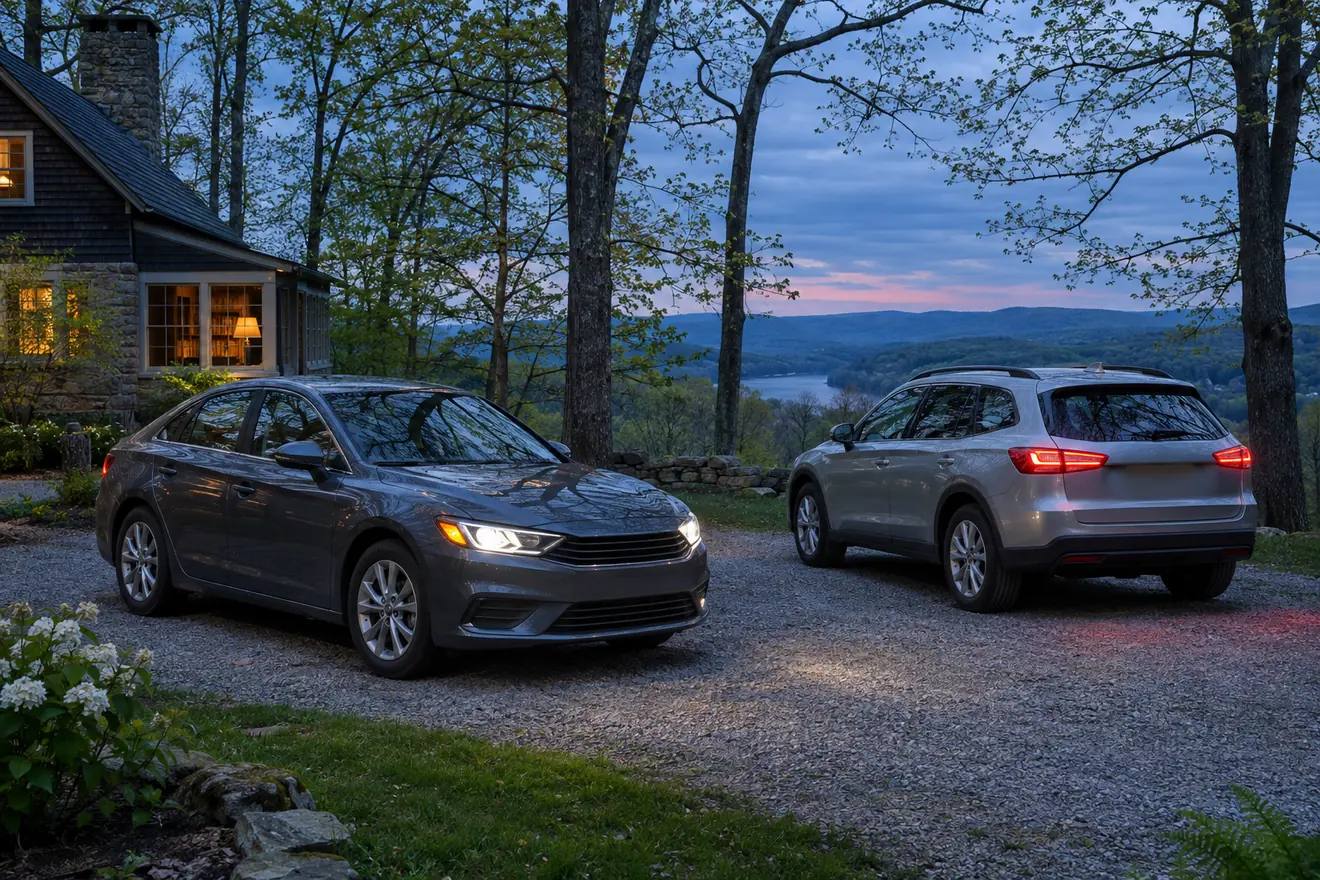
New York's headlight laws sit in Vehicle and Traffic Law (VTL) section 375. In short: headlights must be on from half an hour after sunset to half an hour before sunrise, whenever the windshield wipers are running, and whenever visibility ahead is not clear for 1,000 feet. The same section requires two matched headlamps, approved equipment, no dangerous glare, red rear lamps and stop lamps, and tight limits on colored and flashing lights. This guide walks through those provisions in plain language, including why a working lamp or a familiar bulb shape does not settle every compliance question.
When lights must be on
Section 375(2)(a) requires lamps to be lit from one-half hour after sunset until one-half hour before sunrise. Lights must also be on whenever windshield wipers are in use because of weather and whenever visibility for 1,000 feet ahead is not clear. These are separate triggers: the lighting requirement can matter during daylight as well as after dark.
Check the lighting controls and confirm which lamps are operating. The provision includes required front and rear lighting; seeing light ahead of the vehicle does not establish that the rear lamps are illuminated.
The main subdivisions at a glance
| Subdivision | Topic | What it says |
|---|---|---|
| 375(2)(a) | Lighting times | Lamps must be on during specified nighttime hours, wiper use and reduced visibility. |
| 375(2)(a)(1) | Front lamps | At least two front headlamps, one on each side, with equal-power sources. |
| 375(2)(a)(3), (4) | Rear lamps and plate light | Two rear lamps showing red visible from 1,000 feet (vehicles made 1952 or later); white light on the rear plate. |
| 375(2)(b) | Glare and adjustment | Avoid dangerous glare or dazzle and observe stated beam-height limits. |
| 375(2)(c) | Light-source power | Contains a 32 candle power limit; check its application with the DMV. |
| 375(3) | Multiple beams | Permits multiple-beam headlamps and requires the lowermost distribution when highway lighting makes more unnecessary. |
| 375(4) | Approval | Headlamps must be commissioner-approved or have an approved lens or device. |
| 375(7) | Sales | Addresses the sale of headlighting devices. |
| 375(34) | Back-up lamp | At least one lamp showing white to the rear when reverse is engaged. |
| 375(40) | Stop lamps | At least two, one per side, showing red to amber and visible at least 500 feet behind. |
| 375(41) | Colors and flashing | Restricts colors and flashing, revolving or moving white lights, with named exceptions. |
Headlamps: number, power and approval
Section 375(2)(a)(1) calls for at least two lighted headlamps on the front, one on each side, with light sources of equal power. When replacing a failed source, check the specified bulb type in the owner's manual; the basics of replacing a headlight bulb cover the practical side. A replacement decision should account for the headlamp assembly as well as the source fitted inside it.
Section 375(4) requires headlamps other than motorcycle headlamps to be approved by the commissioner or to carry a lens or other device approved by the commissioner. The same subdivision requires headlamps to be firmly mounted and readily adjustable. Section 375(7) separately addresses sales of headlighting devices. Availability for purchase does not answer whether equipment meets the requirements for a particular vehicle. For how federal markings relate to this, see the guide to DOT and SAE headlight markings.
Section 375(2)(c) contains a 32 candle power limit for a light source. That wording comes from an older era. Check with the DMV about how it is applied; do not turn it into a modern bulb-shopping rule through an assumed conversion to watts or lumens.
Section 375(2)(d) adds one more case: if a device such as a snow plow blade blocks the headlamps, the vehicle needs at least two additional front headlamps.
Glare, beam height and multiple beams
Section 375(2)(b) requires lamps to be arranged, adjusted and operated to avoid dangerous glare or dazzle. It also states that a lamp's beam must not rise higher than the lamp center at 25 feet ahead, nor higher than 42 inches at 75 feet ahead.
Those distances are statutory limits, not a complete adjustment procedure for every headlamp design. Check the vehicle's adjustment guidance and the assembly's condition before changing aim. The guide to headlight aim and adjustment explains how to approach that work.
Section 375(3) allows multiple-beam headlamps and contains the dimming rules. When a vehicle approaches from ahead within 500 feet, or when the driver is approaching a moving vehicle from behind within 200 feet, the headlamps must be operated so that dazzling light does not interfere with the other driver. The lowermost distribution is required when the highway is lit, or traffic is such that lighting the road more than 200 feet ahead is unnecessary or impracticable. Having a selectable high beam does not remove the duty to avoid dangerous glare.
Rear lamps, plate lighting and stop lamps
For vehicles made in 1952 or later, section 375(2)(a)(3) requires at least two lighted rear lamps, one on each side, displaying red light visible from at least 1,000 feet behind. It also requires white light illuminating the rear license plate so the numerals are legible from at least 50 feet.
Section 375(40) requires at least two stop lamps, one on each side, displaying red to amber light visible at least 500 feet from the rear when the brake is applied. Section 375(34) requires at least one back-up lamp displaying white light to the rear when reverse is engaged.
Check these functions separately. A rear lamp that illuminates with the headlights does not establish that its stop-lamp function works. For changes involving darkened lenses or replacement assemblies, read the guide to tail lights, smoked lenses and LED replacements.
Colored and flashing lights
Section 375(41) contains the colored-and-flashing-light rules. Its general restriction covers lights other than white and flashing, revolving or moving white lights, subject to named exceptions. Read it alongside the provisions that specifically require or permit other colors for rear and stop lamps.
- Red or red-and-white lights have exceptions for authorized emergency vehicles.
- Amber lights have an exception for hazard vehicles during hazardous operations.
- Blue lights have exceptions for volunteer firefighters' vehicles, for police, fire and ambulance vehicles (blue shown to the rear only, alongside red) and for towing hazard vehicles.
- Green lights have an exception for volunteer ambulance members.
These exceptions concern specified vehicles or uses. A color's association with an emergency or service function does not establish permission for an ordinary passenger vehicle.
Underglow, fog lamps and LED bulbs
The section 375 text reviewed does not name underglow, fog lamps or LED bulbs. Those questions therefore require attention to the general approval, glare and color rules, along with the judgment of officers and inspectors. Silence about a product name is not permission.
LED bulbs are covered in their own guide: are LED headlight bulbs legal in New York. Fog lamps and extra lamps are covered in the guides to fog light rules and use and light bars and off-road lamps.
For decorative lighting, the New York underglow guide explains the relevant questions. For an inspection, check the equipment's approved type, operation, mounting and lens condition. The New York lighting inspection guide covers the DMV's listed checks.
This page is general information, not legal advice. Verify uncertain equipment or modification questions with the New York DMV and consult the official section 375 text.
Frequently Asked Questions
Must headlights be on when windshield wipers are in use?
Yes. Section 375 requires lamps to be lit whenever windshield wipers are in use because of weather, including during daylight.
What time do headlights have to be on in New York?
From one-half hour after sunset until one-half hour before sunrise. Lamps are also required whenever visibility ahead is not clear for 1,000 feet, regardless of the clock.
When must I switch from high beams to low beams?
Section 375(3) requires multiple-beam headlamps to be operated so that dazzling light does not interfere with a driver approaching from ahead within 500 feet or a vehicle ahead of you within 200 feet. The lowermost distribution is also required where the road is lit or traffic makes longer illumination unnecessary.
Does section 375 specifically ban underglow by name?
The text reviewed does not name underglow. General color, glare and approval rules still matter, so verify a proposed setup with the DMV.
Can one headlamp have a more powerful light source?
Section 375(2)(a)(1) requires front headlamp light sources of equal power. Check the specified replacement source before changing either side.
Are the statutory beam heights a complete aiming procedure?
No. They state beam-height limits. Use the vehicle's adjustment guidance and check lamp condition when assessing aim.
Does a working light automatically satisfy inspection requirements?
No. The DMV also checks approved type, mounting and lens condition. Operation is one part of the lighting inspection.