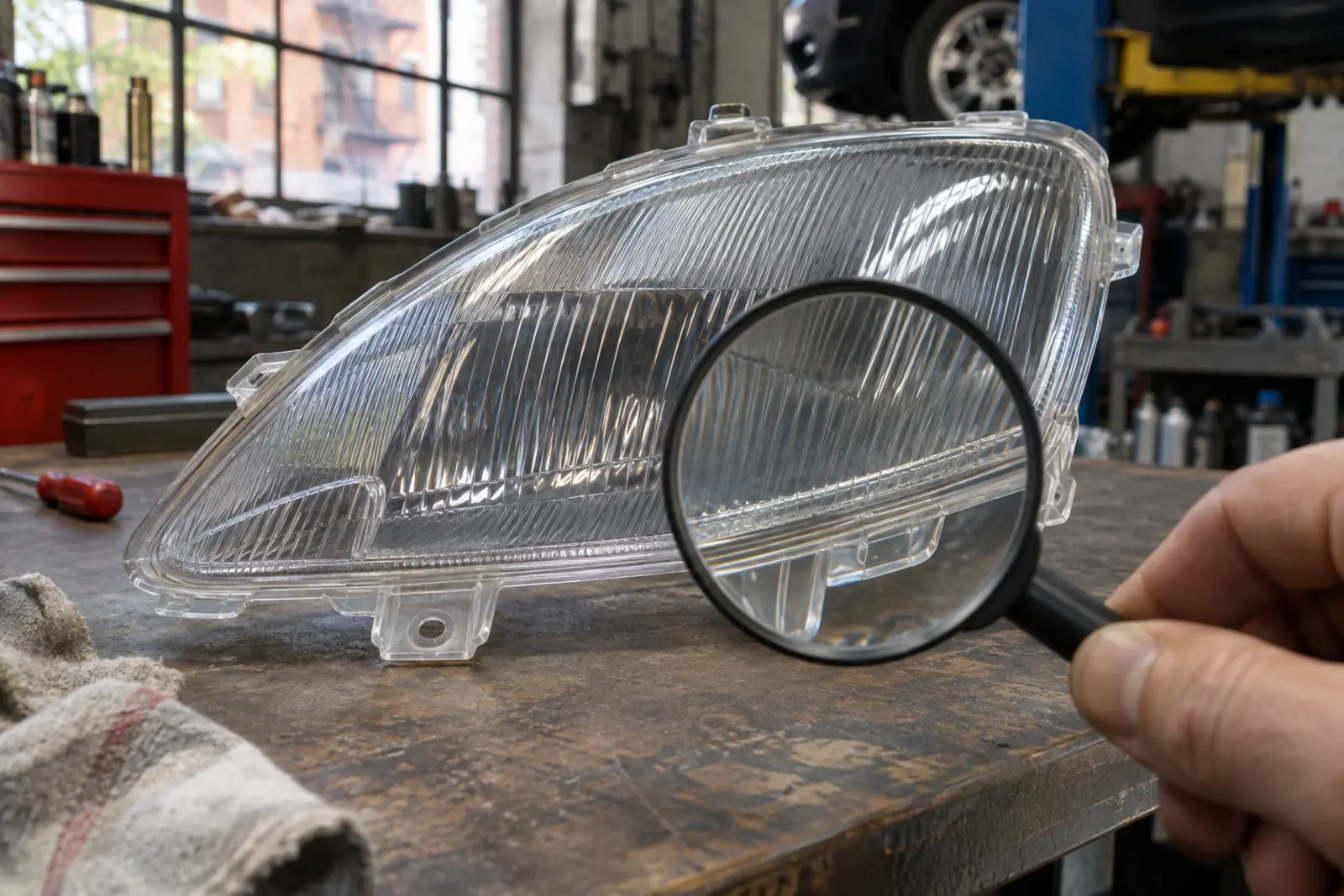
The DOT marking on a headlight lens means the manufacturer certifies that the headlamp meets the applicable requirements of FMVSS 108, the federal lighting standard. It is not an individual approval from NHTSA. SAE markings help identify a lamp’s function or type, but neither marking alone establishes that a modified lighting system is suitable for use on New York roads.
What FMVSS 108 covers
Federal Motor Vehicle Safety Standard No. 108 is titled “Lamps, reflective devices, and associated equipment” and appears at 49 CFR 571.108. It applies to new vehicles and replacement lighting equipment. The federal standard’s full text contains the requirements for the equipment it covers.
Manufacturers self-certify compliance. For headlamps, the standard requires the DOT symbol on the lens as that certification. A driver should therefore read DOT as a statement of responsibility by the manufacturer, rather than evidence that a government agency tested and approved that particular lamp.
This distinction matters when comparing replacement assemblies. A certification mark is useful information, but it does not answer every question about vehicle compatibility, installation, condition, or operation after a modification.
What must be marked on a headlight lens
According to the marking provisions in section S6.5 of FMVSS 108 (as published at Cornell Law School’s Legal Information Institute), a headlight lens carries more than the DOT symbol. The standard sets out these items:
- DOT symbol. The lens of each original and replacement headlamp, and each beam contributor, must carry the DOT symbol, placed horizontally or vertically, to indicate certification (S6.5.1).
- Maker’s name or trademark. The lens must show the registered name or trademark of the headlamp or beam contributor’s manufacturer, its importer, or the vehicle manufacturer (S6.5.3.1).
- Voltage and part or trade number. The headlamp must be marked with its voltage and its part or trade number (S6.5.3.2).
- Light source marking. A replaceable bulb headlamp must be permanently marked in front of each replaceable light source with the bulb type, such as an HB designation for filament sources. No marking is needed if the only source is type HB1 (S6.5.3.4).
- Sealed beam wording. A sealed beam lens must be molded with the words “sealed beam” and a designation code from the standard’s Table II (S6.5.3.3).
- DRL wording. A daytime running lamp that is not optically combined with a headlamp must be permanently marked “DRL” on its lens (S6.5.2).
Other lamps and reflective devices, such as tail lights, may carry the DOT symbol as a certification of conformance (S6.5.1.2), so a tail light with no DOT mark is a different situation from a headlamp with none.
How to read a lamp lens
Start by looking for the DOT symbol, any SAE markings, and manufacturer identification. Record the markings accurately before trying to interpret them. Similar-looking strings can serve different purposes, so avoid guessing from one familiar letter or number.
SAE codes often indicate the lamp’s function or type. Read the owner’s manual or the relevant SAE standard for their meaning. An SAE marking should not be treated as a universal approval for every lighting function or installation.
| Marking | Where found | What it tells you | What it does not tell you |
|---|---|---|---|
| DOT symbol | Headlamp lens | The manufacturer certifies compliance with applicable federal requirements. | It does not show individual NHTSA approval or validate a later bulb conversion. |
| SAE code | Often on a lamp lens | It identifies a lamp function or type; consult the manual or standard. | It does not establish permission for every road use or mounting arrangement. |
| Manufacturer identification | Look on the lens and check equipment documentation. | It helps identify the maker and connect the lamp to its documentation. | Identification alone does not establish compliance or correct vehicle fit. |
| Off-road-only wording | Check equipment labeling and documentation. | The stated intended use excludes ordinary road use. | It does not authorize replacing required road lighting. |
What a missing mark suggests
If a headlamp lens has no visible DOT symbol, pause before selecting it as replacement road equipment. The required certification has not been established by the lens marking. Check the equipment documentation and ask NHTSA about an unresolved federal compliance question.
Do not extend that headlamp rule into an assumption that every auxiliary lamp must carry identical markings. First identify what the lamp does and which requirements govern it. A missing SAE code and a missing required DOT symbol are different questions.
Markings can also become hard to read as a lens ages. Cloudy or yellowed plastic can obscure molded text, and the guide to headlight restoration for yellowed lenses explains what restoration does and does not change about a lens.
The headlamp is a complete system
Headlamp requirements concern the lens, reflector, and light source working together. A replaceable bulb headlamp consists of a bonded lens and reflector assembly with one or two replaceable light sources. Its original DOT marking does not certify every light source that can physically fit inside it.
Halogen lamps use a tungsten filament, HID lamps use an electric arc with a ballast, and LED lamps use light-emitting diodes. The guide to halogen, HID and LED headlight types compares how they differ. Factory LED headlamps are designed with their reflector or projector optics as a complete system. Matching a connector or bulb designation does not establish that a different technology meets the headlamp’s requirements.
In a February 2024 interpretation, NHTSA said LED sources in integral beam headlamps are permitted, but no LED source was then permitted in a replaceable bulb headlamp. It said installation of an LED replacement source was therefore left to state law. The guide to LED bulbs in halogen headlights explains this distinction and the glare concern.
Replacement equipment and business responsibilities
Replacement lighting equipment falls within FMVSS 108. Under S6.7.1.1, a replacement lamp must meet all the requirements for its type and include all the functions it replaces. A replacement lens must show the manufacturer and part or trade number of the headlamp it is intended for, plus the lens maker’s or importer’s registered trademark (S6.5.3.6). Before choosing an assembly or bulb, check the owner’s manual for the specified equipment and compare the replacement documentation with the existing system. Keep the questions separate: what the equipment is, what its markings certify, and whether it matches the vehicle.
A separate federal provision, 49 U.S.C. 30122, addresses making safety devices inoperative. It applies to manufacturers, distributors, dealers, and motor vehicle repair businesses. A business considering a lighting alteration must account for that provision; a customer’s preference for a different bulb does not settle the business’s obligations.
For drivers, the practical point is straightforward: replacing a complete assembly and changing the light source inside an existing assembly are different decisions. Check the basis for the proposed replacement rather than relying on the original housing’s markings. The guide to replacing a headlight bulb covers the routine like-for-like case.
Off-road lamps and New York requirements
Treat off-road-only wording as a reason to check intended use carefully. It provides no basis for using the lamp as a replacement for required headlights on public roads. Mounting an auxiliary lamp also raises separate questions about color, glare, and operation, covered in the guide to light bars and off-road lamps.
Federal certification and New York vehicle requirements answer related questions. New York requires lamps to be arranged, adjusted, and operated to avoid dangerous glare or dazzle. Its lighting provisions also address required lamps and restricted colors. Read the guide to New York VTL section 375 before changing lighting equipment.
The DMV safety inspection checks lighting for approved type, operation, mounting, and lens condition. The guide to what is checked on lights at a New York inspection lists the items in detail. A visible mark does not establish that a damaged, altered, or incorrectly mounted lamp will pass. This guide provides general information, not legal advice. Verify federal certification questions with NHTSA and New York equipment or inspection questions with the DMV.
Frequently Asked Questions
What does DOT SAE mean on headlights?
DOT is the manufacturer’s certification that the headlamp meets applicable federal requirements. SAE markings generally identify a lamp’s function or type. Read together, they describe the lamp and who certifies it, not whether it suits a particular vehicle or modification.
Does DOT mean NHTSA approved the headlamp?
No. The DOT symbol is the manufacturer’s certification of compliance with applicable federal requirements, rather than individual NHTSA approval.
Does an SAE marking mean a lamp can replace a headlight?
No. SAE markings generally identify function or type. Check the owner’s manual or relevant standard for their meaning and the equipment’s intended role.
Does a DOT housing make an LED replacement bulb acceptable?
The housing’s mark does not certify a later bulb conversion. Headlamp requirements concern the complete system, including its light source.
What should I check if a replacement headlamp has no DOT mark?
Under FMVSS 108 the lens of each original and replacement headlamp must carry the DOT symbol. Check the documentation before selecting it for road use. If certification remains unclear, verify the federal requirements with NHTSA.
What other markings should be on a headlight lens?
The standard also calls for the maker’s registered name or trademark, the voltage and part or trade number, and, on replaceable bulb headlamps, a bulb type marking in front of each light source. A sealed beam lens is molded with the words “sealed beam” and a designation code.
Can a marked headlamp still fail inspection?
Yes. New York inspection also checks operation, mounting, lens condition, and approved type, so markings alone do not establish a passing result.