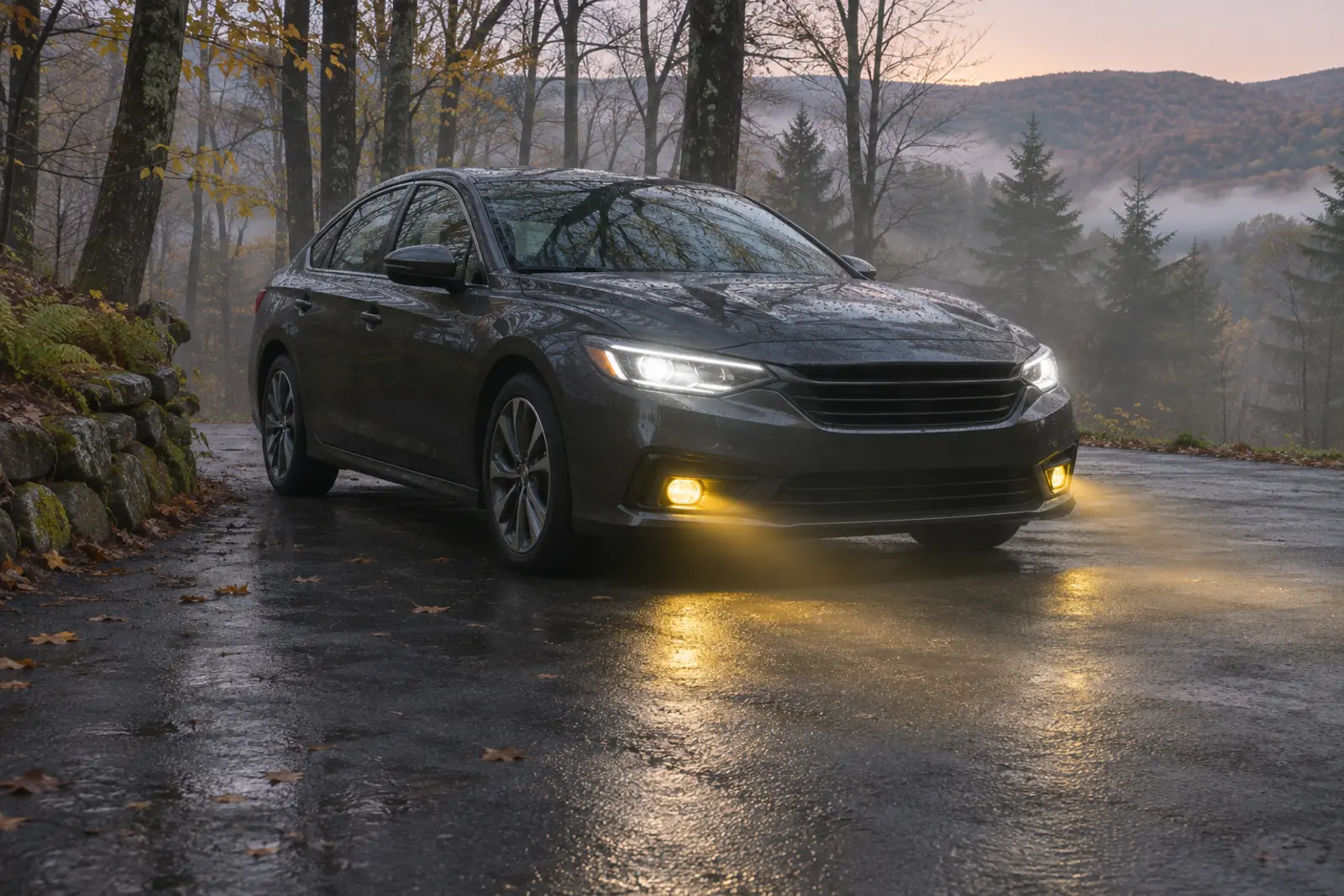
New York's Vehicle and Traffic Law does not name fog lamps, and the rules that apply to them are written around glare and lamp color. White front fog lamps, aimed low and used only when visibility is poor, are the straightforward case. Amber or yellow fog lamps are a gray area: SAE J583 specifies white or selective yellow, but New York's Vehicle and Traffic Law section 375 does not name fog lamps or yellow in the text reviewed, so confirm a specific lamp before relying on it.
Are Fog Lights Legal in NY? What the Law Says
Front fog lamps produce low, wide beams beneath the main headlamp beams to help in fog, heavy rain, or snow. SAE J583’s 2011 revision specifies white or selective yellow, while NHTSA interpretation letters say FMVSS 108 itself does not prescribe fog lamp specifications. That leaves state rules to do the work.
In the section 375 text reviewed for this guide, three provisions bear on fog lamps:
- Glare. Subdivision 2(b) requires lamps to be arranged, adjusted, and operated to avoid dangerous glare or dazzle. It also limits the upper outline of a dazzling beam projected to the left of the vehicle's axis by a headlamp's lowermost distribution, or by the single distribution of any other lamp, to the lamp center height at 25 feet.
- Auxiliary front-facing lamps. Subdivision 3 says that, on a vehicle so equipped, auxiliary front-facing lamps must be operated so that dazzling light does not interfere with the driver of an approaching vehicle.
- Colored lights. Subdivision 41 starts from a white-light rule and then lists specific exceptions: red for authorized emergency vehicles, amber for hazard vehicles and certain other listed uses, blue and green for certain volunteer members. Fog lamps and yellow are not named.
Under subdivision 32(a), violations of section 375 other than those involving adequate brakes are punishable by a fine of up to $150 or up to 30 days in jail, or both, unless the section provides otherwise, according to the statute text. The guide to New York’s lamp and color rules explains the broader framework.
Are Yellow or Amber Fog Lights Legal in NY?
There is no simple yes or no. SAE J583’s 2011 revision identifies white and selective yellow for front fog lamps, and that is the reason yellow fog lamps exist as an equipment category. That standard does not establish permission for every yellow bulb or auxiliary lamp on a New York vehicle. The lamp’s purpose, installation, glare, and applicable state requirements still need consideration.
New York’s colored-light provision does not list yellow among its exceptions in the reviewed text, and it also does not carve out fog lamps. Because the text is silent in both directions, a lamp that is clearly white, front-facing, low-aimed, and used only in poor visibility is the lowest-risk choice. For a yellow or amber lamp, ask the New York DMV or an inspection station before installing it. Do not assume that selective yellow’s inclusion in an SAE standard settles how New York treats a particular lamp.
Fog Light Legal Color: White vs. Selective Yellow
NHTSA interpretation letters explain that FMVSS 108 does not itself prescribe fog lamp specifications. States regulate auxiliary lamp colors, sometimes through references to SAE standards. Avoid treating an advertisement’s reference to a federal standard as a complete answer about an installation.
- White: consistent with the white-light starting point in New York’s colored-light rule and with SAE J583.
- Selective yellow: named in SAE J583, but not addressed by name in the New York text reviewed.
- Blue, red, green, and other colors: do not fit front fog lamp use; section 375 reserves red, blue, and green for specific emergency and volunteer uses.
For the actual wording, check Vehicle and Traffic Law section 375. Fog lamp color is only part of the question; auxiliary lamps built for off-road use raise separate issues, covered in the guide to light bars and off-road lamps on the street.
What Front Fog Lamps Do
Fog lamps supplement the light from headlamps. Their low, wide pattern serves a different purpose from the main beams: lighting the nearby roadway during poor visibility. They are not a replacement for headlamps, and switching them on does not satisfy a requirement to have headlamps lit.
The useful question is whether the extra light helps reveal the road ahead. A brighter patch immediately in front of the bumper does not necessarily make driving easier. Keep attention on the distance visible ahead, and turn fog lamps off when conditions clear.
When to Use Fog Lights
Use low-beam headlamps as the starting point in fog, heavy rain, and snow. Add front fog lamps when their low pattern improves the view. A clear night generally does not call for them. More illuminated lamps are not automatically more useful, especially if their aim causes glare.
| Condition | Headlamps | Fog lamps | High beams |
|---|---|---|---|
| Fog | Use low beams | Use if they improve the nearby view | Avoid; reflected light can obscure the view |
| Heavy rain with wipers operating | Headlamps must be lit; use low beams | Use if helpful | Avoid when reflected light reduces visibility |
| Snow with reduced visibility | Use low beams | Use if helpful | Avoid when snow reflects light back |
| Clear night | Use the appropriate headlamp beam | Leave off | Use only when conditions permit without dangerous glare |
| Daytime rain with wipers operating | Headlamps must be lit | Optional supplement if helpful | Unnecessary for this purpose |
Why High Beams Can Make Fog Harder to See Through
High beams send light into the fog ahead, where droplets scatter some of it back toward the driver. The result can be a bright veil that makes the roadway harder to distinguish. Falling snow can create a similar problem. Low beams, with fog lamps if helpful, are the practical starting point.
Keep Fog Lamps Aimed Low
A fog lamp should retain its low, wide pattern. Raising it to reach farther can put light where it creates glare, and section 375 requires lamps to be adjusted to avoid dangerous glare or dazzle. A loose mount, damaged bracket, or unsuitable replacement bulb also deserves attention before the lamp is used.
Check the vehicle manufacturer’s aiming instructions before turning adjustment screws. Do not invent a universal wall measurement for every fog lamp. Lamp design and mounting position matter, and a headlamp adjustment procedure may not be the specified procedure for an auxiliary lamp.
- Look for secure mounting and damaged lenses.
- Confirm that the installed bulb matches the specified type.
- Follow the manufacturer’s aiming procedure and reference points.
- Check the pattern again after repairs or changes to the lamp.
If the main beams also seem misplaced, use the headlight aim guide to understand the checks involved. Adjusting fog lamps cannot correct poorly aimed headlamps. Lighting is also part of the annual check, so see what New York State inspection checks on lights.
Replacing Fog-Lamp Bulbs
Start with the owner’s manual and the lamp’s specified replacement source. A bulb that fits the opening is not necessarily a suitable optical match. The position and shape of the light source affect how the reflector or projector directs light. The headlight bulb replacement basics cover the general handling steps.
Halogen uses a tungsten filament, HID uses an electric arc and ballast, and LED uses diodes with heat-management components. Changing technologies can change the beam pattern; the comparison of halogen, HID, and LED headlights explains the differences. Do not make a blind LED substitution based only on socket fit, advertised brightness, or color.
NHTSA’s February 2024 interpretation about LED replacement sources addresses replaceable-bulb headlamps; it should not be stretched into a blanket answer for fog lamps. The LED retrofit guide explains why headlamp optics and the replacement source must be considered together. For a fog-lamp change, check the vehicle and lamp manufacturer’s guidance and verify applicable requirements with the DMV.
Wipers, Headlamps, and Daytime Running Lamps
New York requires lamps to be lit whenever windshield wipers are in use. Section 375 also requires lighting from one-half hour after sunset to one-half hour before sunrise, and when visibility for 1,000 feet ahead is not clear. The required display is two lighted headlamps on the front, one on each side, so fog lamps alone do not meet the requirement.
Do not assume daytime running lamps mean the required lighting is on. Check the owner’s manual for the controls and operating behavior of the vehicle’s lighting system, including any automatic setting. When wipers are operating, confirm that the headlamps are lit.
This guide provides general information, not legal advice. Verify fog-lamp color and installation questions with the New York DMV, and federal equipment questions with NHTSA.
Frequently Asked Questions
Are yellow fog lamps allowed in New York?
SAE J583 specifies white or selective yellow, but that alone does not resolve New York requirements. Section 375 does not mention yellow or fog lamps in the text reviewed, and its colored-light rule starts from white. Check with the DMV about the particular lamp and installation.
Are amber fog lights legal in NY?
The amber lights section 375 names are for hazard vehicles and a few other specific uses. That does not describe a passenger car’s fog lamps, so amber is not clearly addressed. White is the lower-risk choice; for amber, get an answer from the DMV or an inspection station first.
Can fog lamps replace low-beam headlamps?
No. Fog lamps supplement headlamps and do not satisfy New York’s requirement to have two lighted headlamps on when required.
Should fog lamps stay on during a clear night?
Leave them off when conditions are clear. Use them when their low, wide pattern helps in fog, heavy rain, or snow. Auxiliary front-facing lamps must not dazzle approaching drivers.
Can an LED bulb go into any fog lamp?
Socket fit alone does not establish suitability. Check the specified light source, manufacturer guidance, beam pattern, and applicable state requirements before changing technologies.
Are daytime running lamps enough when the wipers are on?
Do not assume they are. New York requires headlamps to be lit when windshield wipers are in use, so check the vehicle’s lighting controls and confirm headlamp operation.
What is the penalty for a lighting violation under section 375?
Subdivision 32(a) sets a fine of up to $150 or up to 30 days in jail, or both, for most violations of the section other than those involving adequate brakes, unless the section provides otherwise. Check the current statute for the exact penalty that applies.