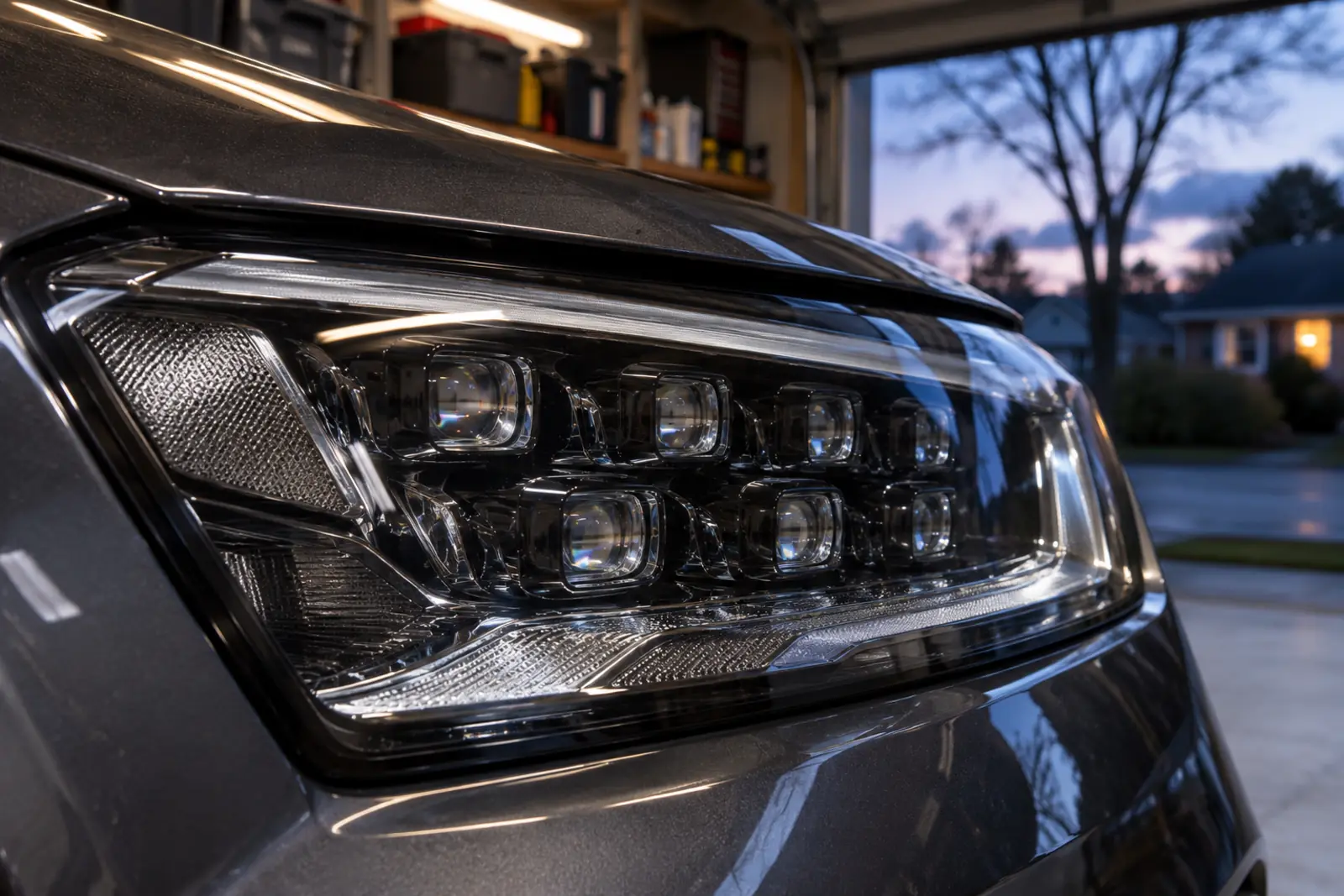
NHTSA’s final rule, 87 FR 9916, published and effective February 22, 2022, amended FMVSS 108 to permit adaptive driving beam (ADB) headlamps on vehicles sold in the United States. The rulemaking followed a vehicle manufacturer’s petition; a Federal Register notice dated December 30, 2024, responded to petitions for reconsideration. For owners, the practical focus is the vehicle’s factory lighting system and its documented features, rather than a replacement bulb advertised as “matrix.”
What adaptive driving beam headlights do
Think of ADB as a high beam that can shade the portions of the road occupied by other vehicles while keeping other areas illuminated. The beam changes its distribution instead of treating the entire road ahead as one lighting zone. This guide explains that general concept; the exact features and operating instructions belong in the vehicle’s owner’s manual.
“Matrix” describes an approach to controlling portions of the beam. The useful question for a driver is what the complete headlamp system actually does. A feature name alone does not establish that a particular vehicle has functioning ADB, or that its equipment meets the requirements for vehicles sold in the United States.
ADB, automatic high beams and swiveling headlights
These features address different tasks. Simple automatic high beams switch between high and low beam. Curve-adaptive lamps swivel the beam toward a bend. ADB changes the distribution of light to shade other vehicles. Check the manual’s description rather than assuming that any feature called “adaptive” includes all three functions.
| Feature | What it does | Note |
|---|---|---|
| Adaptive driving beam | Shades areas occupied by other vehicles while illuminating other areas. | Check the factory system’s documented features. |
| Matrix lighting | Controls portions of the beam to shape its distribution. | The name alone does not confirm ADB operation. |
| Automatic high beams | Switches between high and low beam. | Switching beams differs from selectively shading them. |
| Curve-adaptive lighting | Swivels the beam toward a curve. | Steering the beam does not by itself establish ADB capability. |
| Factory LED headlamps | Uses light-emitting diodes with optics designed around them. | An LED headlamp is not necessarily adaptive. |
What the federal rule changed
The important regulatory change is specific: NHTSA amended FMVSS 108 to permit ADB systems. The February 2022 final rule is the official source for that amendment. Its effective date does not establish which features are fitted to an individual car.
FMVSS 108 is Federal Motor Vehicle Safety Standard No. 108, “Lamps, reflective devices, and associated equipment,” at 49 CFR 571.108. It covers new vehicles and replacement lighting equipment. Headlamp lenses must carry the DOT symbol as the manufacturer’s certification. The separate guide to FMVSS 108 and DOT/SAE markings explains how to read those markings without treating them as confirmation of every advertised feature.
The whole system matters: lens, reflector and light source work together. A marking on a lens does not identify every function available to the driver. Likewise, the federal amendment does not establish that an older vehicle can acquire ADB through a bulb change or an undocumented setting change.
What this means for an owner
Start with the factory equipment
For an owner evaluating ADB, start with the factory system specified for the vehicle. Look for an explicit description of adaptive driving beam operation in the owner’s manual. Read the instructions for selecting lighting modes, recognizing indicators and responding to faults. If the wording describes only automatic high-beam switching, do not assume it also describes selective shading.
- Confirm the lighting equipment fitted to the particular vehicle.
- Read what each automatic lighting setting does.
- Check the manual’s operating instructions and limitations.
- Use manufacturer guidance to identify the correct replacement equipment.
- Investigate abnormal operation instead of assuming automation will compensate.
A replacement bulb does not create ADB
ADB is a coordinated headlamp function, not a bulb specification. An older halogen headlamp contains optics designed around its intended light source. Replacing that source does not establish that the assembly can detect other vehicles or shade selected portions of the beam.
Factory LED headlamps are designed as complete systems with their reflector or projector optics. For the basic differences between light sources, see halogen, HID and LED headlights. Keep the distinction clear: the technology producing the light and the system controlling its distribution answer different questions.
NHTSA’s February 2024 interpretation distinguished LEDs in integral beam headlamps from LED sources in replaceable bulb headlamps. It stated that no LED light source was then permitted in a replaceable bulb headlamp and left installation of such a source to state law. The ADB rule therefore should not be read as permission for an LED bulb conversion.
Repair, replacement and aim still matter
Treat an adaptive headlamp as a complete lighting assembly when planning repairs. Follow the vehicle manufacturer’s procedure to determine what can be serviced and when a whole unit needs replacement. Do not assume that a failed factory LED assembly takes a replaceable capsule like an older halogen lamp.
Correct aim remains important. An adaptive feature does not remove the need to check mounting, lens condition and beam direction. If illumination seems poor or the beam appears misplaced, use the manufacturer’s instructions and the guide to headlight aim and adjustment before attempting changes.
New York operation and inspection
New York VTL section 375 requires lamps to be arranged, adjusted and operated to avoid dangerous glare or dazzle. It also requires lighting during specified nighttime hours, when windshield wipers are in use, and when visibility ahead is insufficient. An automatic lighting feature does not replace those operating requirements.
The DMV safety inspection checks lighting for approved type, operation, mounting and lens condition, including low and high beams. This page provides general information, not legal advice. Verify current federal equipment questions with NHTSA and New York operating or inspection questions with the DMV.
Frequently Asked Questions
Are adaptive driving beam headlights permitted in the United States?
Yes. NHTSA’s final rule published and effective February 22, 2022, amended FMVSS 108 to permit ADB headlamps on vehicles sold in the United States.
Are automatic high beams the same as matrix headlights?
No. Simple automatic high beams switch between high and low beam. ADB selectively shades portions of the beam.
Can an LED bulb give an older car adaptive headlights?
A bulb replacement does not create ADB. The function depends on a coordinated lighting system.
Does an adaptive headlamp still need its aim checked?
Yes. Correct beam direction, sound mounting and lens condition remain important. Follow the vehicle manufacturer’s adjustment and repair instructions.