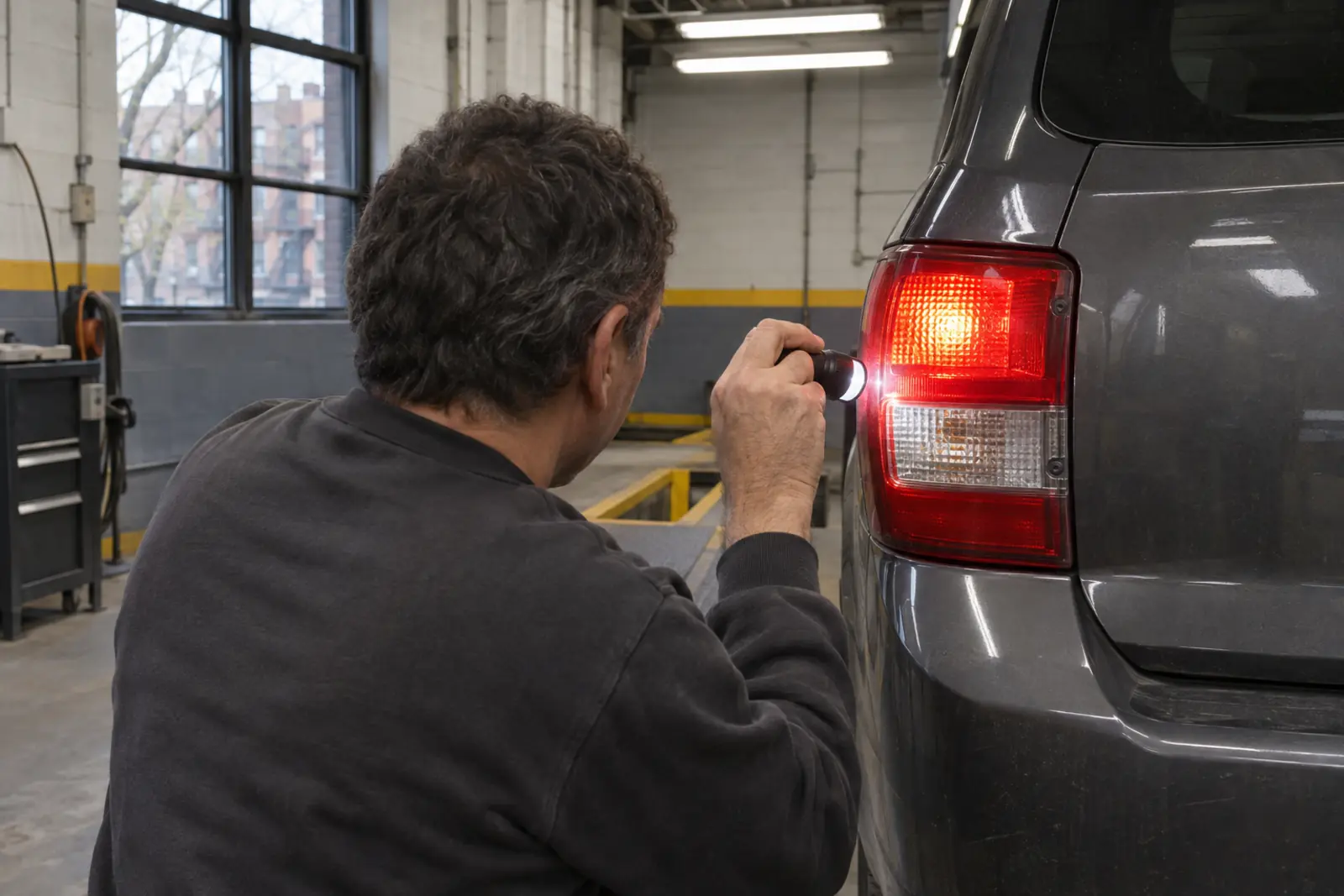
A New York safety inspection checks the lights on the car for four things: whether each is an approved type, whether it works, whether it is properly mounted, and whether any lens is broken or missing. Low and high beams, tail lamps, stop lamps, turn signals, backup lights, plate lights and hazard flashers are all on the list. Because operation is one of the four checks, a headlight that does not light is a defect an inspector can reject; after repair, the car must pass a new inspection.
Which lights does the New York state inspection check?
The DMV’s lighting checklist covers more than headlights. A working low beam does not establish that the high beam, brake lamps, or license plate lighting also work. Check each function separately, including the directional signal indicator inside the vehicle.
| Item | What the DMV page says | Note |
|---|---|---|
| Headlamps | Low and high beams are inspected. | Check both beam settings on each side. |
| Tail lamps | Included in the lighting inspection. | Check separately from stop lamps. |
| Stop lamps | Included in the lighting inspection. | Check with the brake pedal pressed. |
| Directional signals | Included in the lighting inspection. | Check both directions. |
| Backup lights | Listed for 1969 and newer vehicles. | The DMV page specifies this model-year limit. |
| License plate lights | Included in the lighting inspection. | Check illumination of the rear plate. |
| Hazard four-way flashers | Listed for 1966 and newer vehicles. | The DMV page specifies this model-year limit. |
| Directional signal indicator | Included in the lighting inspection. | Check the indicator inside the vehicle. |
Lights the DMV page excludes
Side marker lamps, parking lamps, and add-on flashing side turn lamps are not inspected under the published checklist. That exclusion describes the inspection’s scope. It does not establish permission to change those lamps to any color or operating pattern.
Inspection requirements and road-use requirements answer different questions. For the rules on required lighting, colors, and glare, read the guide to New York Vehicle and Traffic Law section 375. A lamp’s absence from the inspection list should not be treated as approval of a modification. The same applies to underglow and neon lighting, which the inspection checklist does not mention.
Warning lamps on the dashboard are a separate matter
The checklist concerns exterior lighting. The emissions part of the inspection tests the malfunction indicator (“check engine”) lamp through the on-board diagnostics system, which is a different check from the lights. According to the DMV, the air bag warning lamp and tire pressure are advisory items and are not grounds for rejection.
Can you pass inspection with a headlight out?
Practically, no. The DMV lists headlamps among the lights inspected for operation, so a low or high beam that does not light is a defect the inspector can reject. The DMV page does not say how many burned-out lights lead to a rejection, so do not count on a single dead lamp being overlooked. Fixing a dead lamp before the visit avoids a failed inspection.
The same logic applies to a dead brake lamp, tail lamp, turn signal or plate light. Each is a separate item on the checklist.
What can lead to a lighting rejection?
An inspector can reject lighting that does not meet applicable requirements for approval, operation, mounting, or lens condition. The DMV summary specifically identifies broken or missing lenses. Other visible problems deserve attention, but a symptom alone does not establish the inspection result.
- Burned-out or non-working lamps: A listed light that fails to operate, in either beam setting or on either side, is a defect an inspector can reject.
- Cracked or fogged lenses: An inspector can reject a lamp when damage or deterioration makes its condition unacceptable. Check whether the problem is exterior haze, a crack, or something inside the assembly.
- Moisture: An inspector can reject a lamp if moisture accompanies an unacceptable lens condition or interferes with operation. Do not assume every trace of moisture has the same cause or result.
- Unmatched bulbs: An inspector can reject an unsuitable pairing when the lighting fails applicable requirements. New York law calls for front headlamp light sources of equal power.
- Wrong color: An inspector can reject lighting whose color does not meet applicable requirements. A colored bulb or lens needs more scrutiny than a claim that it fits. The page on smoked and LED tail lights covers the rear-lamp side of this.
- Unapproved aftermarket lenses: An inspector can reject a replacement that does not satisfy the approved-type requirement. Appearance and physical fit do not establish approval.
- Loose mounting or failed operation: An inspector can reject a lamp that is improperly mounted or does not perform its required function.
Replacement bulbs need to match the headlamp
Check the owner’s manual for the specified bulb designation before buying a replacement. Headlamp requirements concern the complete system: light source, reflector, and lens. A bulb fitting into the opening does not establish that the resulting headlamp meets those requirements.
NHTSA’s February 2024 interpretation said no LED light source was then permitted in a replaceable-bulb headlamp under the federal requirements, while installation was left to state law. Before changing a halogen headlamp’s light source, read about LED bulbs in halogen headlights. A brighter appearance is not evidence of approval or controlled glare. Lamps that carry approval markings are explained in the guide to DOT and SAE headlight markings.
New York inspection lights checklist: prepare before the visit
Work through the lights before the inspection date, leaving time to investigate anything uncertain. A second person can help observe rear lamps while the controls are operated. Keep the vehicle stationary and follow its operating instructions, especially when checking reverse lighting.
- Check both headlight settings. Operate low and high beams. Look for a lamp that stays dark or an obvious difference between the two sides.
- Check each rear-light function. Observe tail lamps, stop lamps, backup lights, and rear plate illumination separately. One working function does not confirm the others.
- Operate signals and hazards. Check both directions, the four-way flashers, and the directional signal indicator inside the vehicle.
- Examine lenses and mounting. Look for cracks, missing sections, haze, moisture, and loose assemblies. Identify the actual defect before choosing a repair.
- Review previous modifications. Check replacement bulbs, tinted lenses, and changed assemblies against the vehicle’s requirements. Keep any available approval information for the replacement equipment.
- Confirm the repair works. Repeat the relevant checks after replacing a bulb or repairing an assembly. Check all lighting again before inspection.
For a failed replaceable bulb, the headlight bulb replacement guide explains how to start with the correct designation and vehicle instructions. Avoid choosing a different light-source technology simply because the original bulb has stopped working.
Beam aim and fog lamps
The DMV lighting list names operation, approved type, mounting and lens condition; it does not publish an aim procedure. A headlamp that lights but points too high or too low is still a problem on the road, and how headlight aim is checked is covered separately. Auxiliary lamps have their own rules, set out in the guide to fog lights in New York.
Approach yellowed lenses as a condition problem
On an older vehicle, exterior lens deterioration deserves attention even when both bulbs illuminate. Inspect the assembly before deciding that polishing will address the problem. The guide to restoring yellowed headlight lenses explains the limitations of restoration. Clearer appearance alone does not establish acceptable beam performance or guarantee an inspection pass.
Inspection timing, repairs, and re-inspection
New York requires inspection at least every 12 months, performed by a certified inspector at a licensed station. The inspection must happen before the current sticker expires, and the DMV says a new registrant must have a vehicle inspected when it is registered in a different name.
If lighting needs repair, the work can be done at any registered repair shop or by the owner; the inspecting station is not required to do it. The station must get your permission before starting any repairs. The vehicle must then pass a new inspection at a station of your choice before a sticker is issued, so completing a repair does not itself establish a passing result.
This guide provides general information, not legal advice. Verify current inspection requirements and questions about unusual lighting with the New York DMV. The official DMV vehicle inspection program page provides the published lighting checklist and explains the repair and inspection process.
Frequently Asked Questions
Are both low and high beams checked?
Yes. The DMV lighting checklist includes both low and high beams, so test both settings before inspection.
Are parking lamps and side marker lamps inspected?
The DMV page excludes parking lamps, side marker lamps, and add-on flashing side turn lamps. Their exclusion does not settle whether a modification complies with road-use rules.
Will a fogged headlight automatically fail?
The DMV summary does not establish an automatic result for every fogged lens. An inspector can reject a lamp when its condition does not meet applicable requirements.
Does a working LED replacement bulb guarantee a pass?
No. Operation is only one part of the inspection; approved type, mounting, and lens condition also matter.
Must repairs be completed at the original inspection station?
No. Repairs can be completed elsewhere or by the owner, but the vehicle must then pass a new inspection.
Is the check engine light part of the lighting inspection?
No. The malfunction indicator lamp is tested through the on-board diagnostics check in the emissions part of the inspection. The lighting checklist covers the exterior lamps and the turn signal indicator.