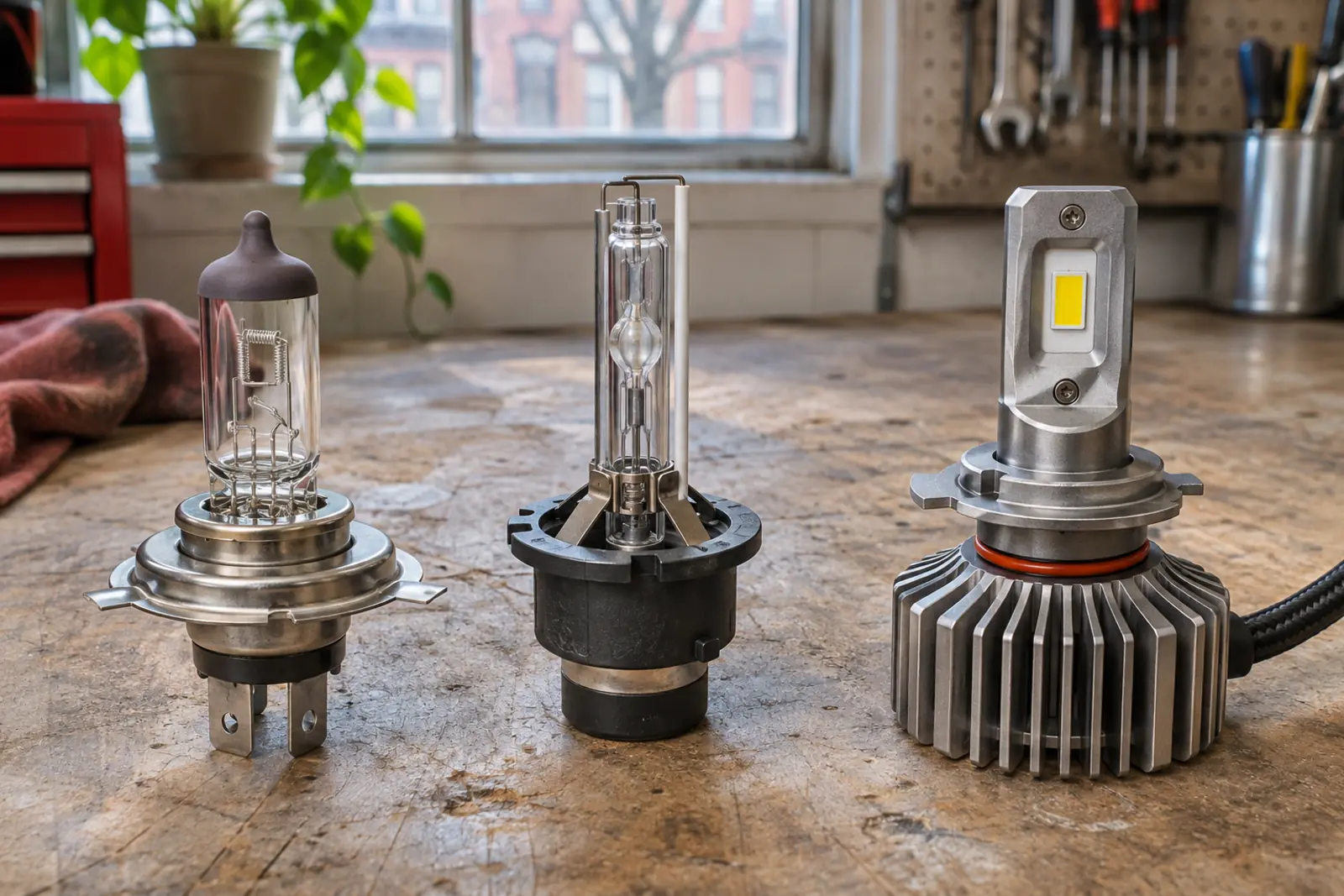
Halogen headlights make light with a heated filament, HID (xenon) headlights use an electric arc, and LED headlights use light-emitting diodes. Each technology has different maintenance needs, but the bulb type alone does not tell you how well a headlight illuminates the road. The reflector or projector, lens, light source and aim work together to determine useful illumination and glare.
In short: halogen is the simplest and cheapest to service, HID usually puts out more light per watt but needs a ballast and a warm-up, and LED switches on instantly and is the common choice in newer factory headlamps. None of the three is automatically better; the finished headlamp is what counts.
How the three technologies work
Halogen: a heated filament
A halogen bulb contains a tungsten filament inside a capsule filled with halogen gas. Electrical current heats the filament until it produces light. The capsule is a replaceable part in a headlamp designed for that bulb type.
Halogen light becomes usable promptly, without the warm-up associated with an HID arc. Common bulb types run on roughly 40 to 72 watts and produce about 700 to 2,100 lumens depending on the type, according to the Wikipedia headlamp article (for example, an H11 is rated at 55 W and 1,350 lumens, an H9 at 65 W and 2,100 lumens). Bulb replacement is generally a simpler maintenance job than repairing a system with a ballast or integrated electronics, although access varies by vehicle. Lifespan depends on the bulb and operating conditions; the same article puts typical halogen life at about 450 to 1,000 hours. Use the vehicle’s specified replacement rather than assuming every halogen capsule is interchangeable.
HID: an arc and a ballast
HID, also called xenon lighting, produces light through an electric arc inside a capsule. A ballast supports the arc’s operation: it delivers a high-voltage pulse to start the arc, then regulates power while the lamp runs. This means the system includes more than a bulb and its connector.
An HID lamp takes time to reach its settled output after starting. Factory HID headlamps typically produce about 2,800 to 3,500 lumens from 35 to 38 watts, and the light is cooler and bluer than halogen (around 4,200 K, versus roughly 3,000 to 3,550 K for halogen), with an average life of about 2,000 hours, per the same article. When maintenance is needed, the capsule, ballast and associated components must be considered together. A fault should be diagnosed before replacing parts. Replacement cost and service complexity can be greater than a straightforward halogen bulb change, depending on the vehicle. Older HID capsule types (D1 and D2) contain mercury, and the D3 and D4 types, in production since 2004, are not electrically or physically compatible with headlamps designed for the earlier types.
LED: diodes with thermal management
LED headlights produce light with light-emitting diodes. Heat sinks and, in some designs, fans manage heat. Factory LED headlamps are designed around those light sources and their reflector or projector optics.
LED output responds promptly when switched on. Long service life is a potential advantage, but it does not make the headlamp maintenance-free. Electronics and thermal management remain part of the system. Check the vehicle’s service information to determine whether a failed component is separately serviceable or requires assembly replacement. One practical point for New York winters: LEDs do not emit the infrared energy that lets halogen and HID lamps thaw snow and ice on the lens, so snow can build up unless the design routes heat to the lens. Clear the lenses of snow before driving.
Halogen, HID and LED compared
| Technology | How it makes light | Replaceable bulb? | Typical use | What to know |
|---|---|---|---|---|
| Halogen | A tungsten filament heated inside a halogen-filled capsule | Yes, in a replaceable-bulb headlamp | Headlamps designed around a specified filament capsule | Match the specified bulb designation and check lens condition and aim. |
| HID | An electric arc inside a capsule, supported by a ballast | The capsule is replaceable in systems designed for replacement. | Headlamps with optics and electrical equipment designed for an arc source | Allow for warm-up and diagnose the capsule and ballast as a system. |
| LED | Light-emitting diodes with thermal management | Serviceability varies; check the vehicle’s instructions. | Factory headlamps designed around LED sources and matching optics | An LED replacement advertised to fit a socket does not establish headlamp compliance. |
HID vs LED vs halogen: which is the better choice?
For most drivers the vehicle makes the choice, because a headlamp is designed around one kind of light source. If you are buying a car, compare the headlight rating of the exact trim. If you are repairing one, replace the source with the type the headlamp was designed for. The trade-offs are:
- Halogen: lowest parts cost and the simplest repair; output is the lowest of the three and the light is warmer and yellower.
- HID: high output from relatively few watts; needs a ballast and a warm-up, and older capsule types contain mercury. The Wikipedia article cites one study finding HID light about 40% more glaring than halogen at the same intensity, which is one reason aim and optics matter.
- LED: instant output, compact optics, and a common choice in newer factory headlamps, including adaptive systems (see the guide to adaptive and matrix headlights in the US); repairs may mean replacing a sealed assembly.
Why the whole headlamp matters
The light source supplies light; the optics distribute it. A reflector redirects light from the source, while a projector uses an optical arrangement that includes a lens. Both depend on the source occupying the position and shape for which the headlamp was designed. An outer lens in poor condition can also affect the resulting beam.
Changing technologies inside an existing housing changes one part of that relationship. A replacement that fits the connector may place its light-emitting surfaces differently from the original filament. A brighter-looking source therefore does not establish that more useful light reaches the road or that glare remains controlled.
NHTSA treats headlamp performance as a whole-system question involving the lens, reflector and light source. Its February 2024 interpretation distinguished permitted integral-beam LED headlamps from LED sources installed in replaceable-bulb headlamps. Read the guide to LED bulbs in halogen headlights before treating a bulb swap as an upgrade.
What a system rating tells you
IIHS tests measure how far low and high beams provide adequate illumination on straight and curved approaches, along with low-beam glare. Vehicles are tested as received from the dealer, without aim adjustment. The rating concerns the complete headlight system on the specific trim, rather than awarding a general score to halogen, HID or LED technology.
According to IIHS, illumination counts as adequate at 5 lux measured 10 inches above the ground (a full moon on a cloudless night gives about 1 lux). Each vehicle is driven on five approaches, six times each, with three runs on low beams and three on high beams. When a model offers more than one headlight system, each system gets its own rating.
That distinction helps when comparing vehicles: look for the rating associated with the actual headlamp equipment. The IIHS explanation of headlight testing describes what those measurements cover. A technology label alone cannot substitute for the system’s results.
Cost, lifespan and maintenance
Compare both the immediate repair and the parts the system may need later. A replaceable capsule, an HID ballast and an integrated LED assembly represent different service tasks. Access, component availability and whether parts are separately serviceable affect the practical cost.
Lifespan is also a component question. A light source may last longer while another part of the headlamp needs attention. Avoid treating a general lifespan claim as a promise for the complete assembly.
- Check the owner’s manual for the bulb designation, such as H11 or 9005.
- Confirm the replacement matches the specified system and installation instructions.
- Look for deteriorated lenses and mounting problems before attributing dim lighting entirely to the bulb.
- Check beam aim when illumination or glare is a concern.
For halogen bulbs, the basics of replacing a headlight bulb cover access, handling and matching the designation. When a headlight looks dim because the lens has turned yellow or hazy, headlight lens restoration addresses a cause no bulb change can fix.
Aim deserves particular attention because an otherwise suitable headlamp can direct light poorly when misadjusted. The headlight aim guide explains why adjustment belongs in the diagnosis of dim-road visibility and glare.
Federal requirements and New York checks
FMVSS 108 applies to new vehicles and replacement lighting equipment. Headlamp lenses must carry the DOT symbol as the manufacturer’s certification. That marking belongs in the context of the complete headlamp; it does not establish that a later bulb substitution preserves compliance. The guide to FMVSS 108 and DOT/SAE markings explains that distinction.
New York requires lamps to be arranged, adjusted and operated to avoid dangerous glare or dazzle; the guide to New York headlight laws under VTL 375 covers the lamp and color rules. DMV safety inspections check lighting for approved type, operation, mounting and lens condition, as outlined in the guide to what is checked on lights at a New York inspection. This guide is informational and is not legal advice. Verify inspection requirements with the New York DMV and federal headlamp compliance questions with NHTSA.
Frequently Asked Questions
Are LED headlights always better than halogen headlights?
No. Useful illumination and glare depend on the complete headlamp, its condition and its aim. Compare the specific system rather than relying on its technology label.
What is the difference between HID and LED headlights?
HID creates light with an electric arc in a capsule and needs a ballast and a short warm-up. LED uses diodes, switches on promptly and relies on heat sinks or fans. Neither label guarantees a better beam, because that depends on the optics around the source.
Are xenon and HID headlights the same thing?
Generally yes. “Xenon” is the common name for HID headlights, because these capsules use xenon gas. So “xenon vs LED headlights” is the same comparison as HID vs LED.
Do HID headlights need time to warm up?
Yes. An HID arc takes time to reach its settled output after starting.
Can an LED bulb replace a halogen bulb if the socket matches?
A matching socket does not establish optical compatibility or compliance. The headlamp was designed around a particular light source, and substitution raises both beam-performance and legal questions.
Do LED headlights melt snow and ice off the lens?
Not by themselves. Halogen and HID lamps emit infrared energy that can thaw snow and ice on the lens, while LEDs do not, so snow can build up unless the design moves heat toward the lens. In winter, clear the headlamps by hand.
Does a dim headlight always need a new bulb?
No. Lens deterioration, poor aim or another system fault may contribute. Check the complete headlamp before choosing a repair.