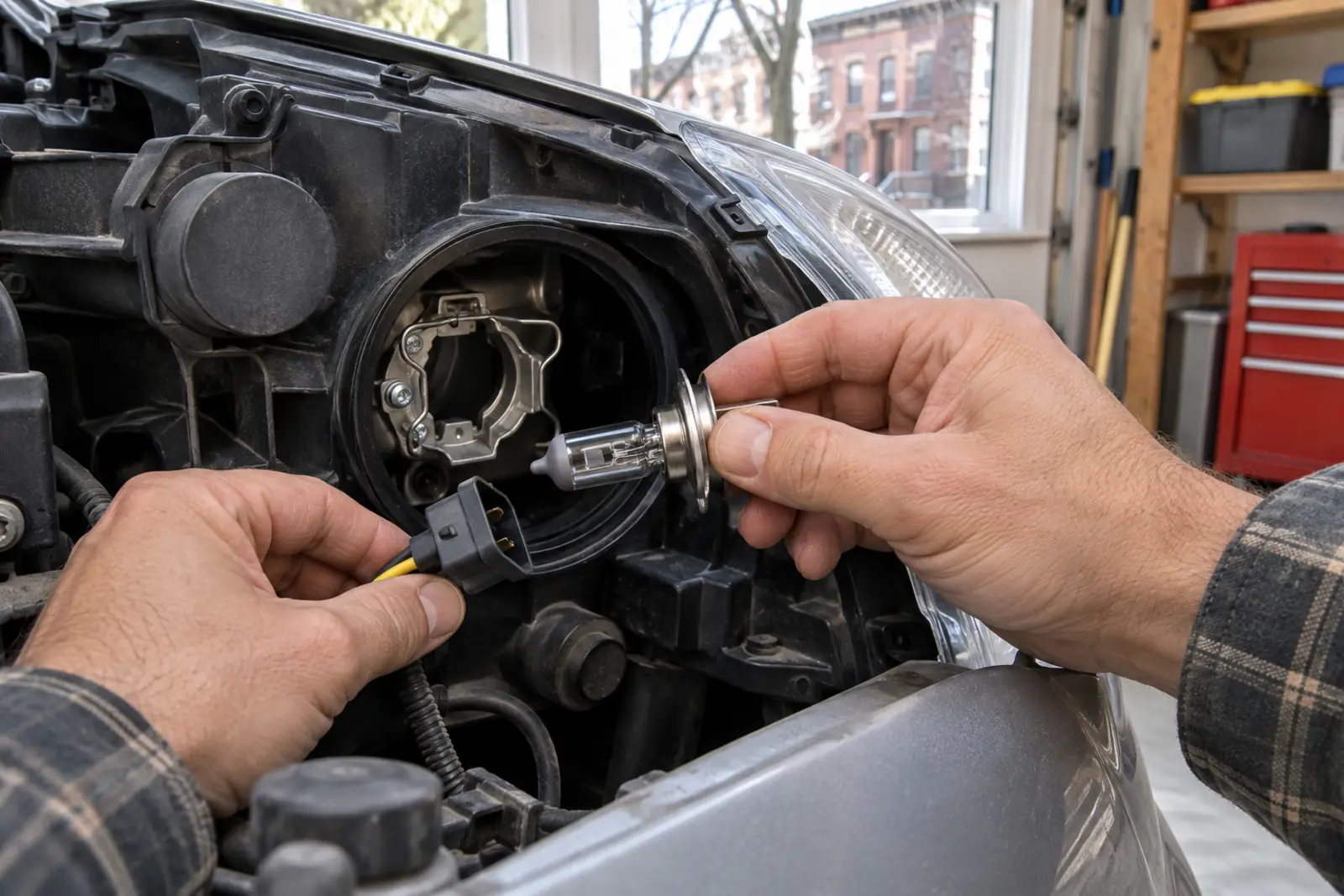
To replace a headlight bulb, find the bulb type in the owner’s manual, buy the same type, and follow the vehicle’s replacement instructions; replacing both sides together is practical when access and cost allow. Switch everything off before starting, let a hot bulb cool, and keep bare fingers off halogen glass because skin oil causes hot spots. Access varies, and some vehicles need a trim part moved. After replacement, check both beams, the housing closure, and headlight aim.
Doing it yourself mostly costs the price of the bulb, while a shop bill is largely labor (see the cost section below). Whether the job is realistic depends on the light source: a halogen capsule is usually an owner-level task, while HID and factory LED systems often are not.
Identify the light source first
A headlight that looks like it has a replaceable bulb may need a different service procedure. Halogen headlights use a tungsten filament inside a capsule containing halogen gas. HID, also called xenon, headlights use an electric arc and a ballast. Factory LED headlights use diodes and are designed with their reflector or projector optics as a complete system. The comparison of halogen, LED and HID headlights explains how the three differ in practice.
Look for the bulb designation in the owner’s manual, such as H11 or 9005. Use the instructions for the light that has failed, since the low and high beams may have different replacement procedures. If the manual does not describe owner replacement, check the vehicle’s service guidance before taking the assembly apart.
| Bulb family | Typical use | Note |
|---|---|---|
| Halogen capsule | Replaceable light source in a halogen headlamp | Match the specified bulb type and keep bare fingers off the glass. |
| HID capsule | Arc light source in a headlamp with a ballast | High voltage requires the prescribed service procedure. |
| Factory LED module | Light source integrated with dedicated headlamp optics | Often not user-serviceable; check the vehicle’s service instructions. |
Can you replace a headlight bulb yourself?
Often yes, when the vehicle has a halogen capsule and the manual shows a clear access route. It becomes a poor DIY job when the manual requires removing large parts to reach the bulb, when the system is HID, or when the light is a factory LED unit. If the manual’s procedure is unclear, stop before disconnecting parts.
Prepare before opening the headlight
Park where the vehicle can remain stationary while the work is completed. Read the full replacement procedure first, including any instructions for moving trim or reaching the rear of the housing. Make sure the replacement matches the specified type before removing the existing bulb.
- Switch off the headlights and vehicle before beginning.
- Allow a hot bulb and nearby parts to cool before handling them.
- Identify the connector, retaining device, and any cover described in the manual.
- For HID systems, follow the high-voltage precautions in the manual or leave the work to someone qualified.
Do not treat an HID capsule as an ordinary halogen bulb simply because it can be removed. If the instructions are unclear, or access requires unfamiliar disassembly, stop before disconnecting parts.
How to replace a headlight bulb: basic steps
These steps explain the general sequence. The owner’s manual takes priority for the retaining mechanism, access route, and reassembly.
- Confirm the correct replacement. Check the bulb designation and specified power. Keep the new bulb protected until it is ready to install.
- Open the access area. Move only the parts identified in the instructions. Note how any cover fits so it can be returned correctly.
- Release the connection and retainer. Follow the prescribed order. If a part does not release as described, check the instructions before using more force.
- Remove the old bulb. Note its orientation and handle it carefully. For a halogen replacement, hold the base and avoid touching the glass with bare fingers.
- Seat and secure the replacement. Position it as instructed, then refit its retaining device and electrical connection. Check that the bulb is seated correctly before closing access.
- Restore covers and trim. Reinstall everything removed for access, then test the lights and check their aim.
Why bare fingers matter on halogen glass
Halogen capsules run very hot. According to Wikipedia’s halogen lamp article, oil from fingertips on the quartz envelope absorbs more heat than clean glass, creating a local hot spot that weakens the quartz, which can make the bulb fail early or even burst. Hold the bulb by its base, and if the glass is accidentally touched, follow the bulb maker’s handling instructions before installation. Do not improvise a cleaning method or assume the mark can be ignored.
How much does a headlight bulb replacement cost?
A halogen bulb is inexpensive; a shop visit costs more mainly because of labor. One repair marketplace’s undated price listings (YourMechanic, checked November 2026) showed about $161 to $177 for several vehicles, built from bulb parts of roughly $15 to $31 plus a labor charge near $146. One listing was $1,371 because the part was far more expensive. Actual prices vary by vehicle, bulb type, access difficulty and shop.
The same source notes that the underlying problem can be in the wiring, terminal connections or bulb socket rather than the bulb. Check the exact part number from the manual before buying.
Match the two sides
New York Vehicle and Traffic Law section 375 requires front headlamps on each side to have light sources of equal power. Match the vehicle’s specified replacement on both sides. A higher-power bulb on one side is not a suitable way to compensate for a dim or deteriorated headlight. The guide to New York headlight laws under VTL 375 covers the rest of the lamp rules.
Replacing bulbs in pairs is practical when both are serviceable capsules and the work is manageable. It is not the same as a legal requirement to replace two bulbs whenever one fails. If replacing only one, check the other side’s specification and operation rather than judging the pair by appearance alone.
Why an LED retrofit is a different decision
A bulb that fits the opening is not automatically suitable for the headlamp. Federal headlamp requirements address the lens, reflector, and light source together. The DOT symbol on a headlamp lens represents the manufacturer’s certification; it does not establish that a different light source works correctly in that assembly. The article on DOT and SAE headlight markings explains what those marks mean.
In a February 2024 interpretation, NHTSA said LED sources in integral beam headlamps are permitted, but no LED light source was then permitted in a replaceable bulb headlamp; installation was left to state law. Check current NHTSA guidance before considering a change. The guide to LED bulbs in halogen headlights explains the system and glare concerns. For routine replacement, keep the specified light-source type.
Check moisture, function, and aim afterward
Before closing the housing, look for moisture or condensation and check the condition and fit of the access cover. Follow the vehicle’s guidance for evaluating moisture. Repeated condensation, visible damage, or water inside the assembly warrants further assessment; a new bulb does not resolve the housing’s condition.
Test the low and high beams after reassembly. If a light still fails, or the two sides look substantially different, check the installation and prescribed troubleshooting guidance before buying more parts. If the new bulb works but the beam still looks dull, a cloudy lens may be the cause; see the guide to restoring yellowed, hazy headlight lenses.
Check aim as well as illumination. New York law requires lamps to be arranged, adjusted, and operated to avoid dangerous glare or dazzle, and subdivision 2(b) of section 375 also limits how high the upper edge of the beam may rise at set distances ahead of the vehicle. Use the headlight aim guide alongside the vehicle’s adjustment instructions. The New York lighting inspection guide explains checks for approved type, operation, mounting, and lens condition.
This guide is general information, not legal advice. Verify New York requirements with the DMV and the official Vehicle and Traffic Law section 375; verify federal equipment questions with NHTSA.
Frequently Asked Questions
Should both headlight bulbs be replaced together?
Replace them in pairs when practical, using the specified type and power. New York requires equal-power headlamp sources on both sides, but that does not require replacing both whenever one fails.
How much does it cost to replace a headlight bulb?
Doing it yourself costs only the bulb; a shop adds labor. One undated repair-marketplace listing showed roughly $161 to $177 total for ordinary vehicles, but prices vary widely with the vehicle and bulb type.
Can bare fingers touch a halogen bulb?
Keep bare fingers off the glass because skin oil causes hot spots that can shorten the bulb’s life. Hold the bulb by its base and follow its handling instructions if the glass is touched.
Why did my new halogen bulb fail so quickly?
Contamination of the glass during installation is one known cause, since oil from skin creates a hot spot on the capsule. A fault in the socket or wiring can also be responsible, so check seating and the specified part number.
Can an HID bulb be replaced at home?
HID systems carry high voltage. Follow the vehicle’s service procedure or leave the work to someone qualified if the required precautions are unclear.
Does a new bulb fix condensation?
A replacement bulb does not resolve the housing’s condition. Check the cover fit and follow vehicle guidance for assessing moisture, especially if it returns.
Is an aim check needed after replacement?
Check aim and beam function after replacement. Correct bulb seating matters, and any adjustment should follow the vehicle’s instructions.