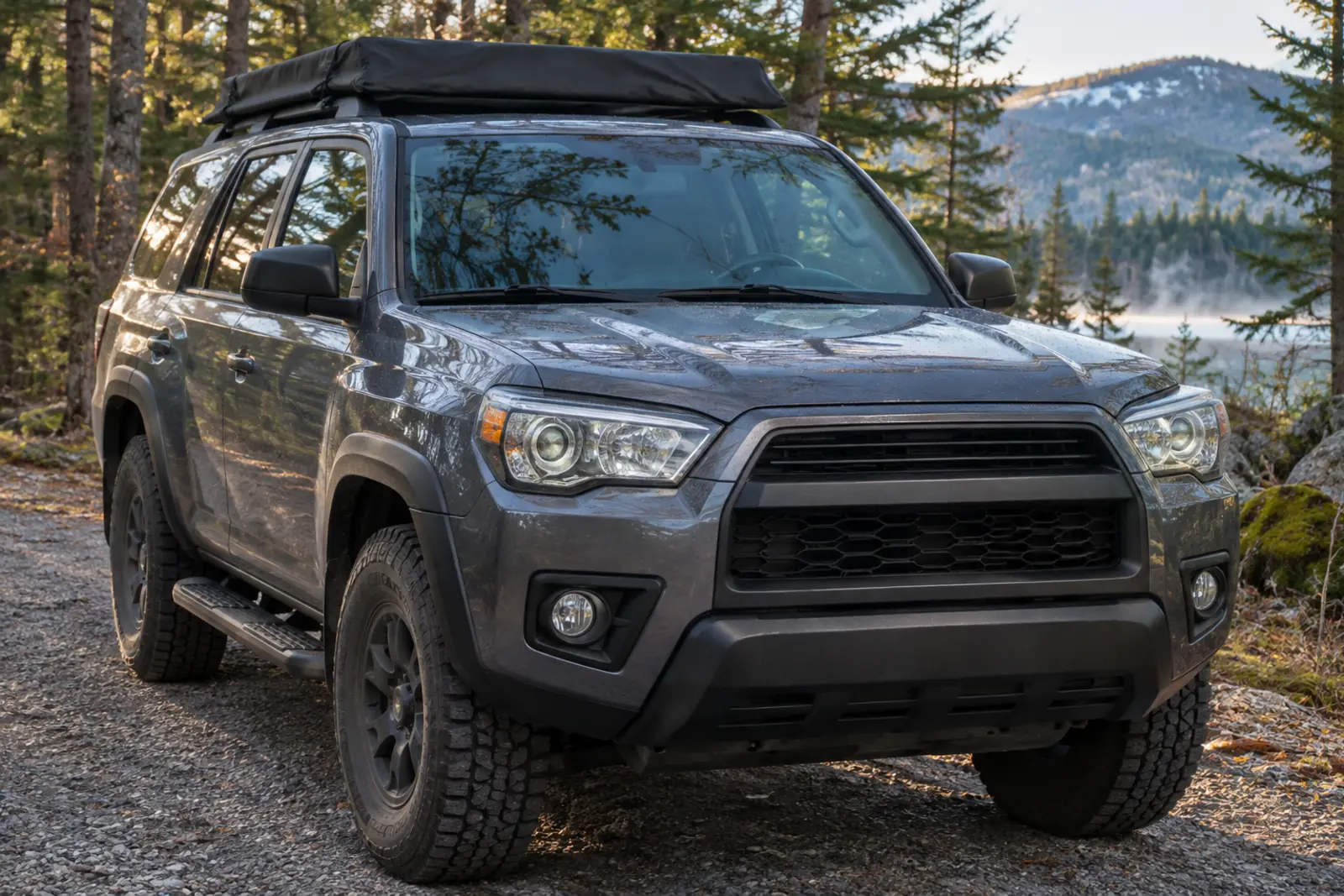
In practice, no: an LED light bar should be treated as off-road equipment, not as something to leave lit on a New York public road. New York's Vehicle and Traffic Law does not mention light bars by name, but the glare rule in VTL 375(2)(b), the white-only and no-flashing rule in VTL 375(41), and the FMVSS 108 principle that additional equipment must not impair required lighting all apply to them. Many off-road lamps are sold as not for highway use, and a separate switch, careful aim or a cover does not by itself make a lamp suitable for road use.
Are LED light bars legal in New York?
There is no statute that says "light bars are legal" or "light bars are banned." The legal question is whether the installed lamp, as it is used on the road, meets the general lighting rules. Subdivision 3 of VTL 375 requires headlamps to be operated so that dazzling light does not interfere with the driver of an approaching vehicle. A high-output bar aimed anywhere near the road ahead is difficult to square with that wording, which is why the safe reading is to keep it off, and ideally covered, whenever you are on a public road.
The same logic answers the related searches. A white bar, an LED bar and a small pod light are judged by what they do on the road, not by the technology inside. The guide to LED headlight bulbs and glare explains the same issue for required headlamps.
What the different beam patterns do
“Light bar” describes a lamp’s shape, not its beam or permitted use. A long housing may contain narrow spot optics, wide flood optics, or a combination. Smaller auxiliary lamps can use the same patterns. Look for documentation describing the intended use and beam pattern before considering mounting locations.
| Lamp type | Beam pattern | Road concern | Practical approach |
|---|---|---|---|
| Spot lamp | Concentrates light in a narrow area ahead | A concentrated beam can create glare when it reaches another driver | Keep trail lighting off on public roads; verify any proposed road use with the DMV |
| Flood lamp | Spreads light across a wider area | Wide illumination may reach opposing traffic and nearby road users | Reserve an off-road flood pattern for appropriate trail conditions |
| Combination bar | Combines narrow and wide illumination | Both portions need consideration; one useful section does not establish suitability of the whole lamp | Check the complete lamp’s documentation and intended use |
| Front fog lamp | Uses a pattern intended for fog-lamp service | Color, aim, and applicable state requirements still matter | Choose equipment documented for that purpose and verify New York requirements |
Light bars on public roads: the glare rule comes first
New York requires lamps to be arranged, adjusted, and operated to avoid dangerous glare or dazzle. Section 375(2)(b) also specifies that a headlamp beam must not rise higher than the lamp center at 25 feet ahead, nor higher than 42 inches at 75 feet ahead. Those provisions are written for headlamps and are not a complete installation recipe for an auxiliary bar.
Aiming a powerful lamp downward does not automatically resolve its road-use status. Beam spread and mounting position still matter. The guide to headlight aim explains why adjustment deserves attention; an off-road lamp should not be treated as interchangeable with a required headlamp.
Color and flashing modes
Section 375(41)(1) prohibits any light other than a white light, and any revolving, rotating, flashing, oscillating or constantly moving white light, except where the subdivision prescribes otherwise for particular vehicles and uses. Many bars offer strobe, chase or colored accent modes; an available mode is not permission to operate it. The explanation of New York lamp and color rules and the fog-light guide cover color in detail, and the official text is in Vehicle and Traffic Law section 375. For colored accent lighting under the vehicle, see the underglow and neon lights guide.
Keep required lighting effective
FMVSS 108 applies to new vehicles and replacement lighting equipment. Under the federal text (49 CFR 571.108, S6.2.1), no additional lamp or other motor vehicle equipment may be installed that impairs the effectiveness of the required lighting equipment. Consider the complete installation: a bar, bracket, cover, or wiring change should not obstruct required lamps or interfere with their operation.
The guide to FMVSS 108 and DOT/SAE markings explains the federal framework. The DOT symbol on a headlamp lens is the manufacturer’s certification, not a blanket approval for every accessory fitted nearby. Required headlamps and auxiliary lamps serve different purposes.
Mounting, switching, and wiring
Choose a mounting position by considering what the lamp will illuminate and where unwanted light could go. A high mounting point is not evidence of road suitability. Check that brackets are secure and that the installation leaves required lighting unobstructed. Follow the vehicle and lamp manufacturers’ guidance for mounting and electrical connections.
- Separate control: Use a clearly identified switch so trail lighting can stay off during road travel. A separate switch is a control measure, not proof of compliance.
- Wiring: Follow the documented wiring arrangement and circuit protection requirements. Avoid changes that interfere with normal headlamp or signal operation.
- Routing: Keep wiring secured and protected according to the installation instructions, including where it passes through bodywork.
- Operating modes: Check how the lamp behaves after switching off and back on, especially if it offers colored or flashing settings.
What covers can and cannot establish
An opaque cover can help keep an off-road lamp from emitting light during road travel. It also provides a visible reminder that the lamp is reserved for another setting. Check that covers are secure and follow the lamp manufacturer’s instructions.
The statutory provisions reviewed for this guide do not establish a universal rule that covering any light bar makes its installation acceptable. A cover does not resolve mounting obstruction or electrical interference. Verify with the DMV whether a particular lamp must be covered, disconnected, removed, or handled another way for road travel.
Using off-road lamps on trails and then returning to the road
Before leaving a trail for a public road, switch off auxiliary equipment intended only for off-road use. Check the required headlamps, tail lamps, stop lamps, and signals. A trail setup that helps reveal nearby obstacles may create unwanted light around other traffic. Rules for trails and private land depend on the land owner or managing agency and are outside what this guide covers.
If the goal is better visibility in fog, start with equipment intended for that purpose. SAE J583 describes front fog lamps as white or selective yellow, while state requirements still govern auxiliary-lamp use. A wide flood beam is not automatically a fog-lamp pattern.
Prepare for inspection without assuming approval
New York’s safety inspection checks specified lighting for approved type, operation, mounting, and lens condition; see the guide to what is checked on lights at inspection. Before inspection, confirm that the accessory installation has not affected required lamps. Ask the DMV about an uncertain configuration before relying on an inspection result as permission to operate every accessory mode.
This guide is informational and is not legal advice. Verify New York installation and operating requirements with the DMV, and verify federal equipment questions with NHTSA.
Frequently Asked Questions
Are light bars street legal?
New York law does not name light bars, so legality depends on how the lamp is used. Glare (VTL 375), the white-only and no-flashing rule (VTL 375(41)) and the FMVSS 108 no-impairment principle all apply. Treat a light bar as off-road equipment and keep it off on public roads.
Can a white light bar be used on public roads?
White color alone does not establish permission. Section 375(41)(1) bars any light other than white except in the cases it lists, but glare, required-lighting performance, and the particular equipment and installation still need evaluation.
Are the strobe or flashing modes on a light bar legal?
Section 375(41)(1) bars revolving, rotating, flashing, oscillating or constantly moving white lights, apart from the exceptions it lists for particular vehicles and uses. A strobe or chase mode on a bar is not an exception for ordinary passenger vehicles.
Does a separate switch make an off-road lamp acceptable?
No. It helps keep the lamp off during road travel, but it does not settle equipment, mounting, or operating requirements.
Is a covered light bar always acceptable?
A cover prevents light emission only when it is opaque and properly fitted. Check with the DMV about the particular installation; covering it does not resolve every concern, such as an obstructed required lamp.
Can a flood light replace a fog lamp?
A flood pattern should not be assumed to meet fog-lamp requirements. Check the equipment’s documented purpose and the fog-light guide, and verify applicable New York requirements with the DMV.