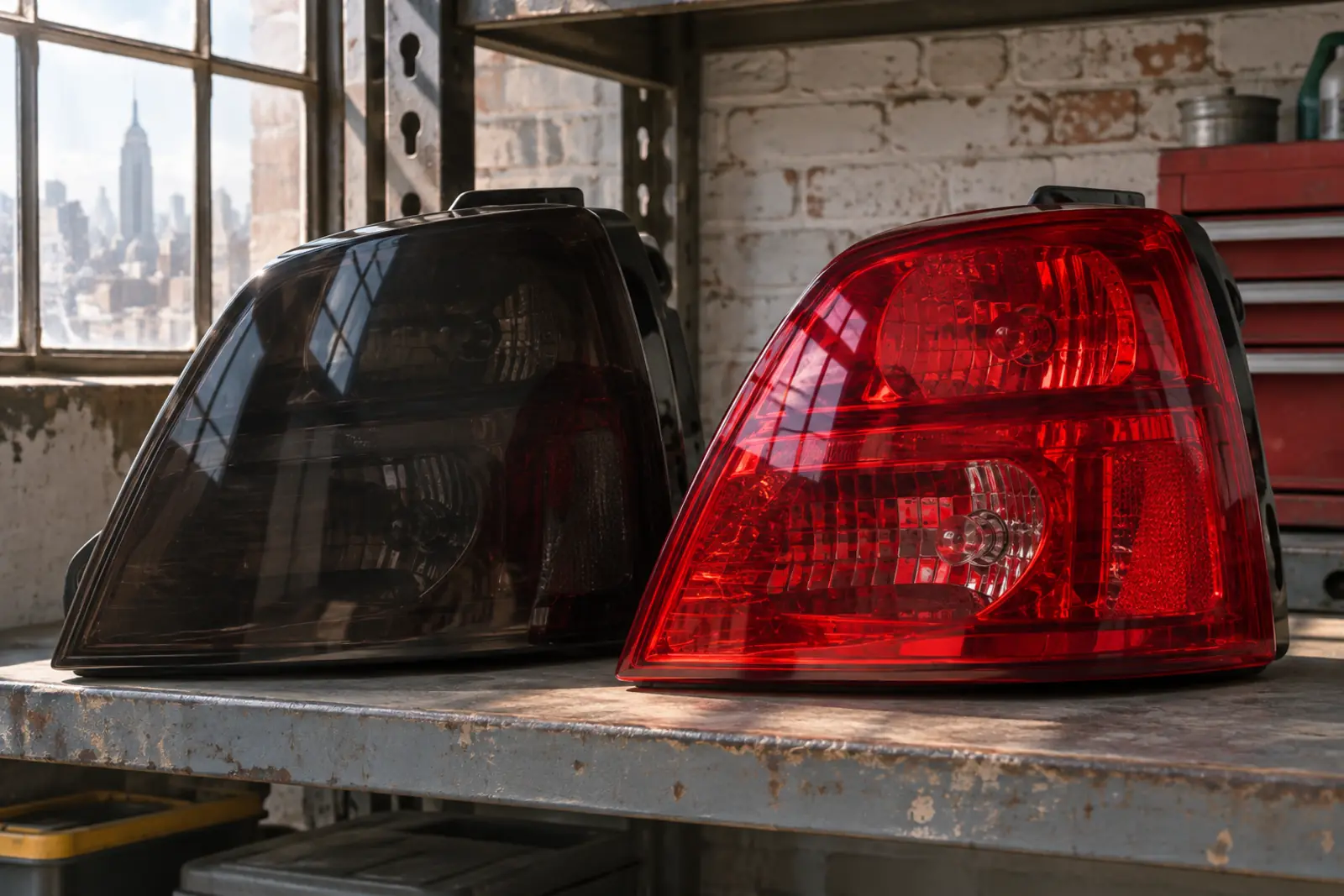
New York law does not give tail lights a legal tint level, so tinted tail lights are not safely legal. Under VTL 375(2)(a)(3), vehicles made in 1952 or later need two rear lamps showing red light visible from at least 1,000 feet, and section 375(40) requires two stop lamps showing red to amber light visible from at least 500 feet. Smoked covers, films and dark lenses reduce the light available to meet those distances, and New York’s safety inspection checks tail and stop lamps for approved type, operation, mounting and lens condition.
Are tinted or smoked tail lights legal in New York?
No section 375 provision allows a set amount of tint on a tail lamp. The statute’s only tinting subdivision, 375(12-a)(b), concerns windows and windshields, so window-tint percentages do not carry over to rear lamps. What the law does set is a performance standard: red light from the rear lamps visible at 1,000 feet, and red-to-amber light from the stop lamps visible at 500 feet. A lamp that falls short of that standard because of a film, cover or dark lens is a poor candidate for legal road use, however good it looks.
LED tail lamps are a separate question. New York does not ban LED technology in rear lamps; the issue is whether the assembly shows the right color, performs each function and is approved equipment. The sections below cover both questions.
What New York requires at the rear
Rear lighting has several separate jobs. Tail lamps identify the vehicle when its lights are on, stop lamps communicate braking, and directional signals communicate an intended turn. A modification needs to preserve each required function, even when several functions share one assembly.
The table below summarizes the relevant requirements in section 375. For context on how these provisions fit together, see the guide to New York’s lamp and color rules. A distance requirement is one part of compliance; it does not replace requirements for approval, operation or condition.
| Lamp | Color rule | Distance in statute | Note |
|---|---|---|---|
| Rear tail lamps | Red | At least 1,000 feet | For vehicles made in 1952 or later, at least two, one on each side. |
| Stop lamps | Red to amber | At least 500 feet | At least two, one on each side. |
| Back-up lamp | White | No distance stated in the cited provision | At least one, showing white to the rear when reverse is engaged. |
| Rear license plate lamp | White | No distance stated in the cited provision | Must illuminate the rear plate. |
Two further points from section 375 apply to rear-lamp upgrades. Subdivision 375(18) makes it unlawful to fail to keep directional signals in good and sufficient working order at all times. Subdivision 375(41)(1) generally prohibits any light other than white, and any revolving, rotating, flashing, oscillating or constantly moving white light, from being displayed on a vehicle except as the section prescribes.
Smoked covers, tint film and dark lenses
A cover or film puts another layer between the lamp and the driver behind. Darkening the lens reduces transmitted light. The practical question is how the altered assembly performs in every required mode, rather than how clearly its LEDs or bulbs can be seen while standing nearby.
There is no tint percentage in the cited provisions that this guide can identify as an acceptable allowance. A claim that a film is “light smoke” does not establish compliance. Neither does a photograph showing the brakes illuminated, because it does not establish visibility at the statutory distance or approved equipment status.
A replacement assembly with a dark appearance needs the same scrutiny. Its appearance does not establish approval, and a claim of brighter LEDs does not establish the performance of the complete lamp. Look for documented intended functions and certification markings, then verify that the equipment meets New York requirements.
What to check on an existing modification
- Identify whether the darkness comes from removable covers, film or the replacement lens itself.
- Check both rear lamps with the running lights on, then check both stop lamps with the brake pedal pressed.
- Check directional signals, hazard flashers, back-up lighting and plate illumination separately.
- Look for damaged lenses, loose mounting or a cover that obscures another required lighting function.
- Resolve uncertain approval or visibility before treating the modification as suitable for road use.
Aftermarket LED tail lamps
LED technology alone does not answer the compliance question. FMVSS 108 (49 CFR 571.108) covers original and replacement lamps, reflective devices and associated equipment. Its section S6.7.1.1 sets requirements that each replacement lamp must meet. A replacement tail lamp must therefore be assessed as a complete assembly, rather than as a collection of bright light sources.
Look for a DOT mark and supporting certification information when evaluating replacement equipment. Under S6.5.1.2 of the standard, the DOT symbol on lamps other than headlamps is permitted rather than required, so a missing mark is not proof of a problem, but it leaves you with less evidence of conformity. Do not treat a mark as permission to add tint afterward. Also avoid transferring a rule between lamp types: the specific DOT lens-marking requirement in S6.5.1 concerns headlamps. The guide to FMVSS 108 and DOT/SAE markings explains that distinction.
Check running and braking functions separately. Where one assembly provides both, look for the intended increase in brightness when the brakes are pressed. An illuminated lamp is not enough evidence if it remains in the wrong mode or fails to communicate braking. Follow the vehicle and replacement-equipment instructions for the intended application.
Front-end LED upgrades raise different questions of glare and housing design; those are covered in the guide on LED headlight bulbs in New York.
Sequential and dynamic turn signals
A sequential signal lights in a sequence; other dynamic designs may use moving patterns. Appearance alone cannot establish whether a particular assembly meets the applicable requirements. Confirm that its intended signal operation is covered by the equipment’s compliance information.
New York section 375 includes restrictions on colored, flashing, revolving and moving lights, with specified exceptions. Do not infer that every animated rear-light pattern is acceptable because directional signals normally flash. Check uncertain equipment or operating patterns with the DMV, and check federal replacement-equipment questions with NHTSA. For other colored accessory lighting, see the guide to underglow and neon lights in New York.
Clear lenses, reverse lamps and plate lights
A clear outer lens does not necessarily mean a lamp displays white light. The relevant rear tail-lamp rule requires red light from the operating lamp. Check the emitted color in its intended mode, along with the assembly’s approval and condition.
Keep the functions distinct. Section 375(34) calls for at least one back-up lamp displaying white to the rear when reverse is engaged; it also says that lamp must not be lit when the vehicle is moving forward. The rear plate also needs white illumination. A red tail lamp, white reverse lamp and white plate lamp serve different purposes; changing an assembly must preserve those functions.
Preparing for the annual inspection
New York requires a safety inspection at least once every 12 months. The lighting check includes tail lamps, stop lamps, directional signals and license plate lamps, along with back-up lights on 1969 and newer vehicles and hazard flashers on 1966 and newer vehicles. Inspectors check approved type, operation, mounting and lens condition.
Before inspection, perform a complete function check and address questionable tint or covers. For the broader checklist, read about lighting at the New York safety inspection. Repairs can be performed anywhere, but the vehicle must pass a new inspection.
This guide is informational and is not legal advice. Verify current equipment and inspection questions with the New York DMV, and consult the official Vehicle and Traffic Law section 375 for the statutory wording.
Frequently Asked Questions
Are smoked tail lights allowed in New York?
A smoked appearance does not establish compliance. The lamps must meet the required color, visibility and equipment requirements, and tint reduces the light available. Section 375 sets no tint allowance for rear lamps.
Is there an acceptable percentage of tail-light tint?
The cited provisions do not provide a tint-percentage allowance. The only tinting subdivision in section 375, 375(12-a)(b), addresses windows and windshields, not lamps. Check with the DMV rather than relying on a film’s shade description.
Are LED tail lights legal in New York?
New York section 375 does not prohibit LED tail lamps as such. The assembly must still show red light visible at 1,000 feet, work as a stop lamp visible at 500 feet, and meet equipment approval, mounting and condition checks.
Can clear-lens tail lights meet the red-light rule?
Clear lenses can display red light, but check the complete assembly’s emitted color, intended functions and approval. Lens appearance alone does not answer the question.
Does a working LED tail lamp automatically pass inspection?
No. Operation is only one part of the check; approved type, mounting and lens condition also matter.